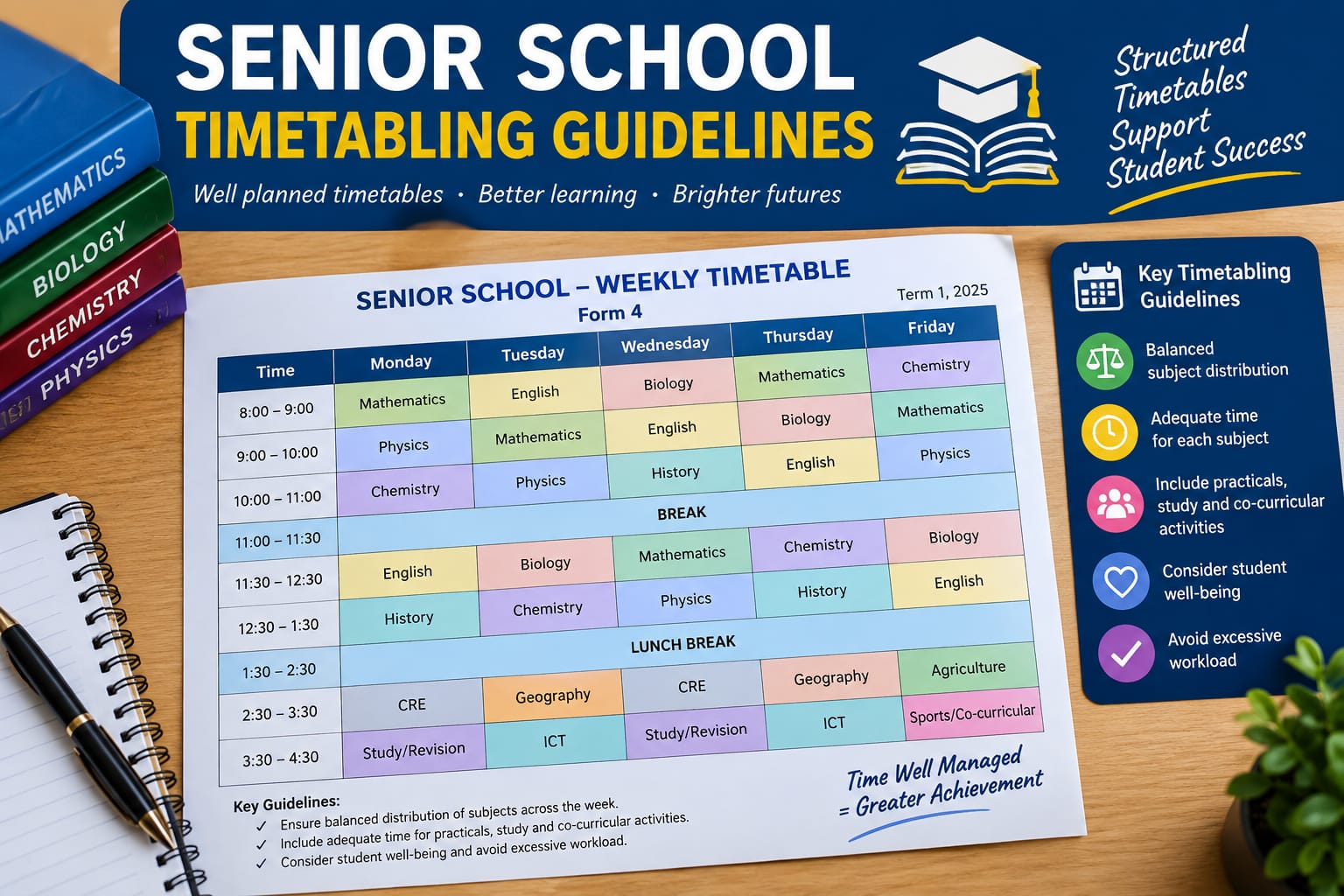
Senior School Timetable 2026: Complete Guidelines for Creating a Balanced CBC Daily Routine
The transition to Senior School is bringing new demands for school administrators, teachers, learners and parents. Unlike a timetable designed simply to fit subjects into a school week, the Senior School timetable must support competency development, practical learning, projects, career pathways, assessment and learner wellbeing.
A well-designed timetable can make curriculum implementation easier. A poorly organised one can create teacher clashes, overcrowded laboratories, rushed practical lessons, excessive learner workload and inadequate time for projects.
As Senior Schools continue adapting to Competency-Based Education (CBE), timetable planning has therefore become an important part of effective school management.
This guide explains the key Senior School timetabling guidelines, daily routine considerations, practical lesson scheduling, teacher workload issues and strategies for creating an effective school timetable.
What Is a Senior School Timetable?
A Senior School timetable is an organised schedule showing when different learning activities take place during the school day and school week.
It normally identifies:
- Learning areas or subjects
- Classes
- Teachers
- Lesson periods
- Practical sessions
- Breaks
- Lunch
- Projects
- Co-curricular activities
- Guidance and counselling
- Other approved school activities
The timetable should reflect the school’s curriculum and available resources.
It should also ensure that learners receive adequate time to develop the knowledge, skills, attitudes and values expected at Senior School level.
Why Senior School Timetabling Is Different
Senior School brings together learners following different interests, subject combinations and pathways.
This makes timetable construction more complex.
A school may need to coordinate:
- Different subject combinations
- Multiple classes
- Teachers with different specialisations
- Laboratories
- Workshops
- ICT rooms
- Art and performance spaces
- Sports facilities
- Practical projects
- Clubs and societies
The timetable must bring all these elements together without creating unnecessary conflicts.
1. Start With the Approved Curriculum
The first rule of effective timetabling is simple:
Start with curriculum requirements, not convenience.
Before preparing the timetable, administrators should establish the learning areas offered by the school and the time requirements attached to them under the applicable curriculum guidance.
The school should consider:
- Subjects offered
- Learner pathways
- Subject combinations
- Number of classes
- Available teachers
- Available learning facilities
- Practical requirements
- Assessment activities
This provides the foundation for the timetable.
2. Make Competency Development the Centre of the Timetable
Senior School should not become a timetable dominated by lectures and note-taking.
Learners need opportunities to:
- Solve problems
- Conduct investigations
- Complete projects
- Work in groups
- Make presentations
- Carry out practical activities
- Conduct research
- Create products
- Develop portfolios
The timetable should therefore provide room for different types of learning.
A lesson does not always have to mean a teacher talking while learners listen.
3. Give Practical Lessons Enough Time
One of the biggest mistakes schools can make is scheduling practical subjects into periods that are too short.
A laboratory experiment, workshop activity or performance may require learners to:
- Prepare materials.
- Receive instructions.
- Perform the activity.
- Record observations.
- Analyse results.
- Clean equipment.
- Reflect on the activity.
This is difficult when the available time is too limited.
Where curriculum requirements permit, schools can use longer or double periods for appropriate practical activities.
4. Create a Balanced School Day
A good timetable should distribute different types of learning throughout the day.
Schools should avoid unnecessarily placing several highly demanding lessons consecutively.
A balanced day can include a mixture of:
- Academic lessons
- Practical learning
- Collaborative activities
- Independent work
- Projects
- Physical activities
The exact order should depend on the school’s curriculum, facilities and operational arrangements.
5. Protect Time for Projects
Project-based learning is an important component of competency development.
Learners may need time to:
- Identify problems
- Research
- Collect information
- Analyse data
- Develop solutions
- Create products
- Prepare presentations
- Document their work
If project work is squeezed into already crowded schedules, learners may end up completing projects simply to meet deadlines rather than genuinely developing competencies.
Schools should therefore deliberately consider project time during timetable development.
6. Integrate Digital Learning
The Senior School timetable should also recognise the growing role of digital learning.
Where facilities are available, learners can use digital platforms for:
- Research
- Online assignments
- Digital presentations
- Simulations
- Collaborative projects
- Digital portfolios
- Revision
- Assessment activities
However, digital learning should complement rather than automatically replace classroom teaching and practical experiences.
7. Include Sports, Clubs and Societies
Learner development extends beyond academic lessons.
The timetable should make reasonable provision for:
- Football
- Athletics
- Volleyball
- Basketball
- Music
- Drama
- Debate
- Journalism
- Environmental clubs
- Science clubs
- ICT clubs
- Leadership activities
These activities can provide opportunities for learners to develop teamwork, communication, leadership and creativity.
8. Build Guidance and Career Support Into School Life
Senior School learners are preparing for important decisions about their future.
Schools should provide opportunities for:
- Career guidance
- Academic counselling
- Personal development
- Mentorship
- Pathway information
- Further education guidance
Career guidance should not be treated as something that only happens when learners are about to leave school.
Regular support can help learners understand the relationship between their subjects, competencies and future opportunities.
9. Avoid Teacher Timetable Clashes
A technically attractive timetable can still fail if it creates teacher clashes.
Before implementation, administrators should verify that:
- A teacher is not assigned to two classes simultaneously.
- A specialist teacher is available when needed.
- Practical rooms are not double-booked.
- ICT facilities are not oversubscribed.
- Workshops are appropriately scheduled.
- Sports facilities are available.
- Classes have suitable rooms.
A timetable audit can help identify these problems before the school term begins.
10. Consider Teacher Preparation Time
Teachers need time to prepare quality lessons.
They also need time to:
- Mark assignments
- Assess projects
- Give feedback
- Prepare practical materials
- Attend departmental meetings
- Support learners
- Participate in professional development
Timetabling should therefore consider teacher workload rather than focusing exclusively on learner schedules.
11. Provide Adequate Breaks
Learners cannot maintain concentration indefinitely.
The daily routine should include appropriate opportunities for:
- Rest
- Meals
- Movement
- Social interaction
- Personal needs
Break periods also allow learners to move between different learning facilities.
This becomes particularly important in large schools where laboratories, workshops and classrooms may be located in different parts of the campus.
12. Design the Routine Around Learning, Not Just Time
A school routine should answer a broader question:
What should learners be doing throughout the day?
The answer should include more than attending lessons.
Learners may need time for:
- Classroom learning
- Practical activities
- Independent study
- Group projects
- Sports
- Clubs
- Research
- Reading
- Guidance
- Reflection
The timetable should therefore be viewed as a framework for the entire learning experience.
13. Allow Room for Learner Support
Some learners require additional assistance.
Schools can use appropriate periods for:
- Remedial learning
- Academic consultation
- Mentorship
- Individual support
- Career guidance
- Special educational needs support
A flexible timetable can make it easier for teachers to identify and support learners who need additional attention.
14. Do Not Overload Learners
More lessons do not necessarily mean better learning.
An overloaded timetable can leave learners:
- Tired
- Less attentive
- Unable to complete assignments
- Less interested in co-curricular activities
- Unable to devote enough time to projects
Senior School timetabling should therefore seek a sensible balance between instructional time, independent learning, practical work and learner wellbeing.
15. Create a Timetable That Can Adapt
School activities do not always follow the timetable perfectly.
There may be:
- Sports competitions
- Educational trips
- Practical assessments
- School events
- Teacher professional development
- Examinations
- Community activities
Administrators should therefore have procedures for making temporary timetable adjustments without disrupting the entire school programme.
Digital timetable systems can also make it easier to communicate changes to teachers and learners.
Sample Senior School Daily Routine
The following is an illustrative structure, not a replacement for official curriculum or school operating requirements.
| Session | Main Activity |
|---|---|
| Early morning | Arrival and school preparation |
| Session 1 | Academic learning |
| Session 2 | Academic/practical learning |
| Break | Rest and refreshments |
| Session 3 | Classroom learning |
| Session 4 | Practical/project-based learning |
| Lunch | Meals and recreation |
| Session 5 | Academic learning |
| Session 6 | Projects/practical activities |
| Afternoon | Sports, clubs and co-curricular activities |
| Later routine | Personal study and other school-approved activities |
Schools should determine the exact timing according to their approved schedule and local circumstances.
Senior School Timetabling Checklist for Administrators
Before releasing a timetable, administrators can check the following:
Curriculum
☑ All required learning areas are included.
Teachers
☑ Teacher availability has been checked.
Facilities
☑ Laboratories, workshops and ICT rooms are appropriately scheduled.
Practical learning
☑ Practical activities have adequate time.
Projects
☑ Learners have opportunities to complete project work.
Assessment
☑ Assessment activities can be accommodated.
Co-curricular activities
☑ Sports, clubs and societies have been considered.
Learner wellbeing
☑ Breaks and meals are adequately accommodated.
Guidance
☑ Career guidance and learner support are included.
Workload
☑ Teacher workload has been considered.
Flexibility
☑ Procedures exist for handling timetable changes.
Common Senior School Timetabling Mistakes
Treating every lesson the same
A practical laboratory session does not always require the same timetable structure as a theory lesson.
Ignoring facilities
Schools sometimes create timetables without first checking whether the necessary rooms and equipment are available.
Overloading teachers
A timetable should consider preparation and assessment responsibilities.
Leaving projects until the last minute
Projects require planning and sustained learner engagement.
Removing co-curricular activities
Learner development includes more than academic achievement.
Ignoring learner movement
Large campuses require adequate transition time between learning spaces.
Making the timetable too rigid
Schools need mechanisms for responding to unavoidable changes.
How Technology Can Improve Senior School Timetabling
Schools can use digital timetable systems to manage complex schedules.
Technology can help administrators:
- Detect teacher clashes
- Detect room clashes
- Manage subject combinations
- Generate timetable options
- Track teacher allocation
- Communicate timetable changes
- Store timetable versions
- Coordinate multiple classes
However, software should support professional decision-making rather than replace it.
The final timetable should still be reviewed by school administrators and curriculum leaders.
The Ideal Senior School Timetable
There is no single timetable that will work perfectly for every Senior School.
A large boarding school will have different requirements from a small day school.
Similarly, a school with laboratories, workshops and extensive ICT facilities may organise its day differently from a school with limited facilities.
The important principle is to develop a timetable that reflects the school’s actual curriculum, learners, teachers, facilities and educational priorities.
Final Thoughts
The Senior School timetable is more than a document pinned to the staffroom wall.
It is one of the most important tools for turning curriculum plans into everyday learning experiences.
A successful timetable should give learners enough opportunities to learn, practise, collaborate, create, investigate, demonstrate competencies and receive feedback.
For school administrators, the goal should be to create a routine that balances academic learning, practical activities, projects, digital learning, assessment, sports, clubs, career guidance and learner wellbeing.
As Kenya’s education system continues to implement competency-based education, effective timetable planning will become increasingly important in ensuring that Senior School learners do not simply spend more time in classrooms, but use their time to develop competencies that can be applied in school, work and everyday life.