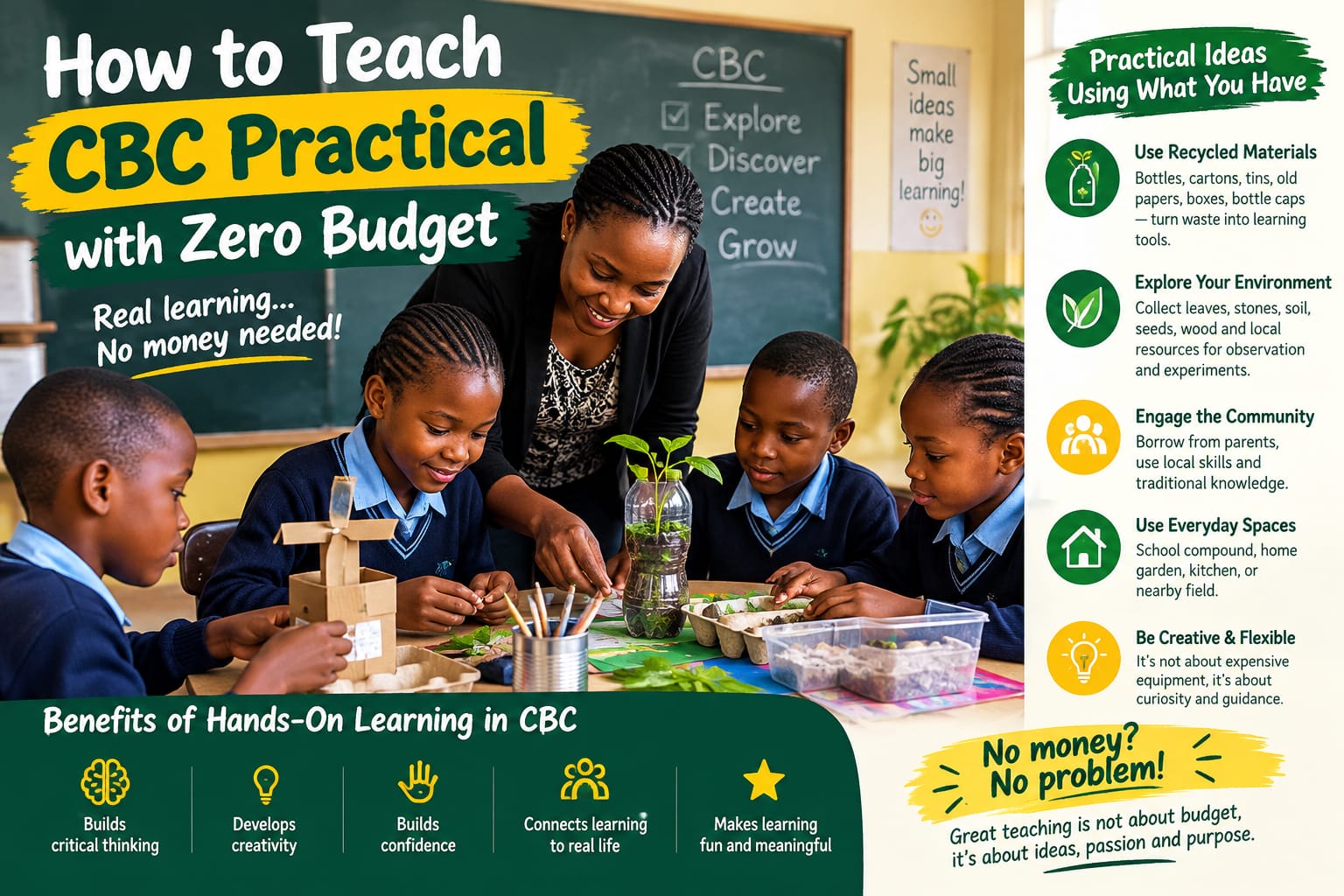
How to Teach CBC Practical Lessons with Zero Budget
Teaching practical lessons under the Competency-Based Curriculum (CBC) can be challenging when a school has limited teaching resources.
Teachers may have ambitious learning activities but lack laboratory equipment, commercial teaching aids, computers, specialised tools or money to purchase materials.
However, practical CBC teaching does not always require a large budget.
The most important question is not:
“What equipment can the school afford?”
Instead, teachers can ask:
“What can learners do with the resources already available?”
The school compound, classroom, recycled materials, learner experiences, community knowledge and everyday problems can all become valuable learning resources.
This guide explores practical ways teachers can implement CBC activities with little or no additional expenditure while encouraging creativity, collaboration, communication, critical thinking and problem-solving.
What Is Practical CBC Teaching?
Practical CBC teaching is an approach in which learners actively participate in learning rather than simply listening to the teacher or memorising information.
Depending on the subject and learning outcome, learners may:
- Conduct investigations
- Make models
- Carry out observations
- Solve real-life problems
- Participate in role plays
- Collect information
- Measure objects
- Conduct interviews
- Create projects
- Present findings
- Demonstrate skills
- Work collaboratively
- Reflect on their learning
The emphasis is on application of knowledge and development of competencies.
A practical lesson does not necessarily mean taking learners into a laboratory.
For some subjects, the classroom, school compound or community can provide an appropriate learning environment.
Why Zero-Budget CBC Teaching Matters
Schools do not have equal access to learning resources.
Some institutions have modern laboratories, digital devices, workshops and well-equipped classrooms, while others operate with limited resources.
A zero-budget approach can help teachers avoid making expensive equipment the starting point of practical learning.
It encourages teachers to:
- Use locally available resources
- Reduce unnecessary expenditure
- Encourage learner creativity
- Make learning relevant to everyday life
- Promote environmental responsibility
- Encourage collaboration
- Connect classroom concepts with the community
Most importantly, limited finances should not automatically mean limited opportunities for active learning.
1. Start With the Competency, Not the Equipment
One of the most important principles of practical teaching is to begin with the learning outcome.
Before preparing an activity, ask:
What should learners be able to do by the end of the lesson?
For example, if learners need to develop measurement skills, they can measure desks, doors, windows or sections of the school compound.
If the learning objective involves classification, learners can classify leaves, stones, soil samples or other safe objects available locally.
If the objective involves entrepreneurship, learners can develop a simple business idea and simulate selling and buying.
The activity should therefore be designed around the competency rather than around expensive equipment.
2. Turn the School Compound Into a Learning Laboratory
The school environment can provide numerous practical learning opportunities.
Teachers can use:
- Trees
- Soil
- Grass
- Flowers
- Stones
- Buildings
- Fences
- Paths
- Drainage channels
- School gardens
- Shadows
- Weather conditions
- Waste materials
For example, a mathematics teacher can use the school compound to teach measurement and geometry.
A science teacher can use plants and soil for observation and classification.
A geography teacher can examine drainage, erosion, vegetation and human activities.
An agriculture teacher can use the school garden to teach crop production.
The environment becomes a living classroom.
3. Use Recycled Materials as Teaching Aids
Teachers can transform waste materials into useful learning resources.
Potential materials include:
- Cardboard
- Old newspapers
- Plastic bottles
- Bottle tops
- Empty containers
- Sticks
- Stones
- Leaves
- String
- Used paper
- Packaging boxes
For example, bottle tops can be used for counting and sorting.
Cardboard can be used to create models.
Old newspapers can provide material for reading and language activities.
Plastic containers can be used in safe demonstrations.
The activity can also help learners understand the importance of reuse and environmental conservation.
4. Let Learners Make Their Own Teaching Materials
CBC practical learning provides an opportunity for learners to become creators of learning resources.
Instead of buying a model, learners can design one.
Instead of purchasing flashcards, learners can make them.
Instead of buying charts, groups can prepare their own.
A teacher can:
- Introduce the concept.
- Explain the expected task.
- Organise learners into groups.
- Allow groups to collect safe, available materials.
- Guide learners as they create.
- Ask groups to present their work.
- Allow classmates to provide feedback.
This can develop creativity, communication, collaboration and problem-solving skills.
5. Use Peer Teaching
Peer teaching is another practical CBC strategy that requires virtually no financial investment.
Divide learners into groups and give each group a different task.
One group can prepare an explanation.
Another can develop questions.
Another can demonstrate a process.
Another can create a practical example.
The groups then share their work with classmates.
This approach gives learners an opportunity to practise:
- Communication
- Leadership
- Collaboration
- Confidence
- Critical thinking
- Creativity
The teacher remains a facilitator and guide.
6. Turn Everyday Problems Into CBC Projects
Real-life problems can become powerful learning opportunities.
Teachers can ask learners to identify problems affecting their school or community.
Possible topics include:
- Littering
- Water wastage
- Poor waste disposal
- Soil erosion
- Food wastage
- Plastic pollution
- Lack of trees
- Energy wastage
- Road safety
For example, learners can investigate waste management in their school.
They could:
- Observe waste disposal practices.
- Identify different types of waste.
- Count or estimate waste collected.
- Classify the waste.
- Discuss environmental effects.
- Develop possible solutions.
- Create awareness materials.
- Present their recommendations.
The activity can integrate several learning areas without requiring expensive equipment.
7. Use Role Play to Make Lessons Practical
Role play can turn an ordinary classroom into a practical learning environment.
Learners can act as:
- Entrepreneurs
- Customers
- Farmers
- Scientists
- Journalists
- Environmental officers
- Community leaders
- Business owners
- Engineers
- Health workers
For example, an entrepreneurship lesson can become a simulated shop.
One learner can act as the shopkeeper while others become customers.
Learners can practise:
- Pricing
- Buying and selling
- Customer service
- Profit calculation
- Record keeping
- Marketing
The classroom becomes a simulated real-world environment.
8. Use Community Knowledge
The community around the school can provide valuable knowledge.
Learners may already have experience with:
- Farming
- Livestock keeping
- Small businesses
- Construction
- Carpentry
- Tailoring
- Food production
- Beekeeping
- Transport
- Crafts
Teachers can connect this local knowledge to curriculum concepts.
For example, a business lesson can examine how a local shop operates.
An agriculture lesson can explore farming practices.
A science lesson can examine traditional ways of preserving food.
This makes learning more relevant to learners’ daily lives.
9. Make Agriculture Lessons Practical
Agriculture is one of the subjects that can easily incorporate zero-budget practical activities.
Depending on the curriculum and available environment, learners can participate in:
- Crop identification
- Seed identification
- Soil observation
- Weed identification
- Composting
- Crop growth monitoring
- Farm planning
- Water conservation
- Pest observation
- Record keeping
A small section of the school compound can potentially become an outdoor learning area.
10. Make Mathematics Practical
Mathematics can be taught using objects and situations learners encounter every day.
Measurement
Learners can measure:
- Desks
- Doors
- Windows
- Trees
- Classroom dimensions
Geometry
Learners can identify:
- Squares
- Rectangles
- Triangles
- Circles
- Angles
- Parallel lines
Statistics
Learners can collect classroom data such as:
- Attendance
- Favourite sports
- Modes of transport
- Types of crops grown at home
- Common household activities
They can then organise the information into tables, charts or graphs.
11. Create Simple Science Investigations
Science practical activities do not always have to begin with sophisticated laboratory equipment.
Teachers can develop simple investigations using safe and readily available materials.
Learners can practise the scientific process:
Question → Prediction → Investigation → Observation → Recording → Explanation → Conclusion
The emphasis should be on developing scientific thinking and observation skills.
Teachers should always ensure that activities are age-appropriate and safe and avoid demonstrations involving dangerous substances or procedures.
12. Use the “Bring What You Have” Approach Carefully
Where an activity requires materials, teachers can ask learners to bring safe, readily available household or recycled materials if they already have them.
For example:
“If available at home, bring an empty cardboard box.”
This approach is different from requiring families to purchase specific materials.
Teachers should be sensitive to differences in learners’ economic circumstances and ensure that lack of a particular material does not prevent participation.
13. Create Learning Stations
Learning stations are useful when resources are limited.
For example:
Station 1: Observation
Station 2: Classification
Station 3: Drawing
Station 4: Problem-solving
Station 5: Discussion
Learners rotate between stations.
This allows one small collection of resources to be shared among several groups.
14. Use Group Work to Overcome Resource Shortages
Suppose a class has only one measuring instrument.
The teacher does not necessarily need to stop the practical lesson.
Learners can work in groups with different responsibilities.
One group can measure.
Another can record.
Another can estimate.
Another can verify the results.
Groups can then rotate.
This transforms resource scarcity into an opportunity to develop teamwork and collaboration.
15. Use Demonstrations When Resources Are Extremely Limited
When there is only one set of materials, the teacher can demonstrate the process to the entire class.
Learners can:
- Observe the demonstration.
- Record observations.
- Discuss what happened.
- Predict the outcome.
- Explain the process.
- Repeat parts of the activity in groups where possible.
A single resource can therefore support an entire lesson.
16. Use Learners’ Experiences as Learning Resources
Every learner enters the classroom with experiences from home and the community.
These experiences can become valuable starting points for learning.
Teachers can ask learners about:
- Farming
- Local weather
- Food preparation
- Small businesses
- Animal keeping
- Local transport
- Environmental challenges
- Community traditions
- Household activities
The teacher can then connect learners’ experiences to the curriculum.
17. Make Assessment Practical
Practical CBC teaching should also be accompanied by practical assessment.
Instead of relying entirely on written tests, teachers can assess learners through:
- Demonstrations
- Projects
- Presentations
- Role plays
- Portfolios
- Observation
- Models
- Group tasks
- Oral explanations
- Problem-solving activities
For example, instead of simply asking learners to define soil erosion, a teacher could ask them to identify signs of erosion around the school and explain possible control measures.
This allows the teacher to observe application of knowledge.
18. A Simple Zero-Budget CBC Lesson Plan
A practical lesson can follow this structure:
Introduction
Present a familiar real-life situation.
Questioning
Allow learners to ask and answer questions.
Group Formation
Create manageable groups.
Resource Identification
Ask learners to identify resources already available.
Practical Activity
Allow learners to investigate, measure, observe, construct or demonstrate.
Recording
Learners record their findings using writing, drawings, tables or diagrams.
Presentation
Groups present their work.
Reflection
Ask learners:
- What did you learn?
- What did you discover?
- What was difficult?
- How did you solve the problem?
- Where can you apply the knowledge?
Assessment
Assess learners using observation, questioning, performance and learner products.
19. Zero-Budget CBC Activity Ideas
| Learning Area | Practical Activity | Possible Resource |
|---|---|---|
| Mathematics | Measure classroom objects | Desks, sticks, string |
| Science | Classify materials | Stones, leaves, paper |
| Agriculture | Identify crops | School environment |
| Geography | Observe drainage | School compound |
| Business | Simulate a shop | Paper, containers |
| English | Conduct an interview role play | Classroom |
| Social Studies | Draw a school map | Paper, sticks |
| Art | Make models | Recycled materials |
| Life Skills | Problem-solving role play | No special materials |
| Environmental Studies | Waste classification | Safe collected waste |
20. How Teachers Can Build a Zero-Budget Resource Bank
Schools can create a simple resource bank by collecting safe reusable materials over time.
A classroom resource box could contain:
- Bottle tops
- Cardboard
- Used paper
- Empty containers
- String
- Sticks
- Newspapers
- Leaves
- Clean packaging materials
Learners can help organise the materials.
Teachers can then reuse them across different lessons.
The resource bank does not have to be expensive. Its value comes from how creatively the materials are used.
The Teacher’s Creativity Can Be More Important Than the Budget
Limited resources should encourage teachers to rethink how practical learning is organised.
The question should not always be:
“What can the school buy?”
It can also be:
“What can learners investigate, create, measure, observe or solve using what is already available?”
A school compound can become a laboratory.
A cardboard box can become a model.
A bottle top can become a mathematics resource.
A community business can become a case study.
A local environmental problem can become a project.
A classroom can become a simulation centre.
This is the power of creative practical teaching.
Final Thoughts
Teaching CBC practical lessons with zero budget is possible when teachers focus on learning outcomes, learner participation, creativity and real-life application.
The absence of expensive equipment does not necessarily eliminate opportunities for practical learning.
By using the school environment, recycled materials, group work, peer teaching, role play, community knowledge and real-life problems, teachers can create meaningful activities without placing unnecessary financial pressure on schools or families.
The goal is not to make a practical lesson look expensive.
The goal is to make learning active, relevant, collaborative and meaningful.
For teachers working with limited resources, creativity can turn the ordinary environment into an extraordinary classroom.
Frequently Asked Questions About Zero-Budget CBC Teaching
1. Can CBC practical lessons be taught without money?
Yes. Many practical activities can use the school environment, recycled materials, learner experiences, group work, demonstrations and community knowledge.
2. What materials can teachers use for practical CBC activities?
Teachers can use safe, readily available materials such as cardboard, paper, sticks, stones, leaves, bottle tops, empty containers and packaging materials.
3. Does practical CBC teaching require a laboratory?
Not every practical activity requires a laboratory. Depending on the learning outcome, activities can take place in the classroom, school compound or appropriate community setting.
4. How can teachers teach CBC when learning resources are limited?
Teachers can use group work, demonstrations, peer teaching, locally available resources, learner-created materials, role play and school-based projects.
5. How can teachers assess practical CBC learning?
Teachers can use observation, demonstrations, projects, presentations, portfolios, role plays, models, oral explanations and problem-solving tasks.
6. How can schools avoid putting financial pressure on parents?
Schools can prioritise resources that are already available and avoid requiring families to purchase materials simply to enable participation in classroom activities.
7. What competencies can zero-budget practical activities develop?
Depending on the activity, learners can develop communication, collaboration, creativity, critical thinking, problem-solving, self-efficacy and other relevant competencies.
8. Can the school environment be used for CBC learning?
Yes. Subject to safety and the specific learning objective, the school compound can provide opportunities for observation, measurement, environmental studies, agriculture, science and other practical activities.