Introduction
The transition from Junior School to Senior School is an important stage in Kenya’s Competency-Based Education system. As learners move into Grade 10, senior schools have an important responsibility to ensure that placed learners are properly verified, admitted and assigned to the appropriate programmes.
For principals, deputy principals, senior school coordinators and other authorised administrators, understanding how to admit Grade 10 learners in the placement system is essential.
The admission process involves more than confirming a learner’s name. Schools need to verify the learner’s placement, assessment details, pathway, track and relevant reporting documents before completing admission.
This guide provides a practical explanation of the Grade 10 admission process, what schools should check, common problems that may occur and how administrators can keep accurate learner records.
What Is the Grade 10 Placement System?
The Grade 10 placement system is an online platform used to facilitate the transition of learners into senior school.
After the selection and placement processes have been completed, learners are assigned to senior schools according to the applicable placement procedures.
The receiving school then has the responsibility of confirming the learners who report to the institution and ensuring that their admission information is correctly captured.
The system therefore plays an important role in connecting learner placement, reporting and school admission.
Grade 10 Selection vs Placement vs Admission
Before discussing the admission procedure, it is important to understand the difference between the three stages.
Grade 10 Selection
Selection is the stage where learners indicate their preferred senior schools, pathways, tracks and subject combinations.
Grade 10 Placement
Placement is the process through which learners are assigned to senior schools.
Grade 10 Admission
Admission occurs when the learner reports to the assigned school, their information is verified and the school completes the necessary admission procedures.
The process can therefore be summarised as:
Selection → Placement → Reporting → Verification → Admission
Choosing a school during selection does not necessarily mean that the learner has been finally placed in that institution.
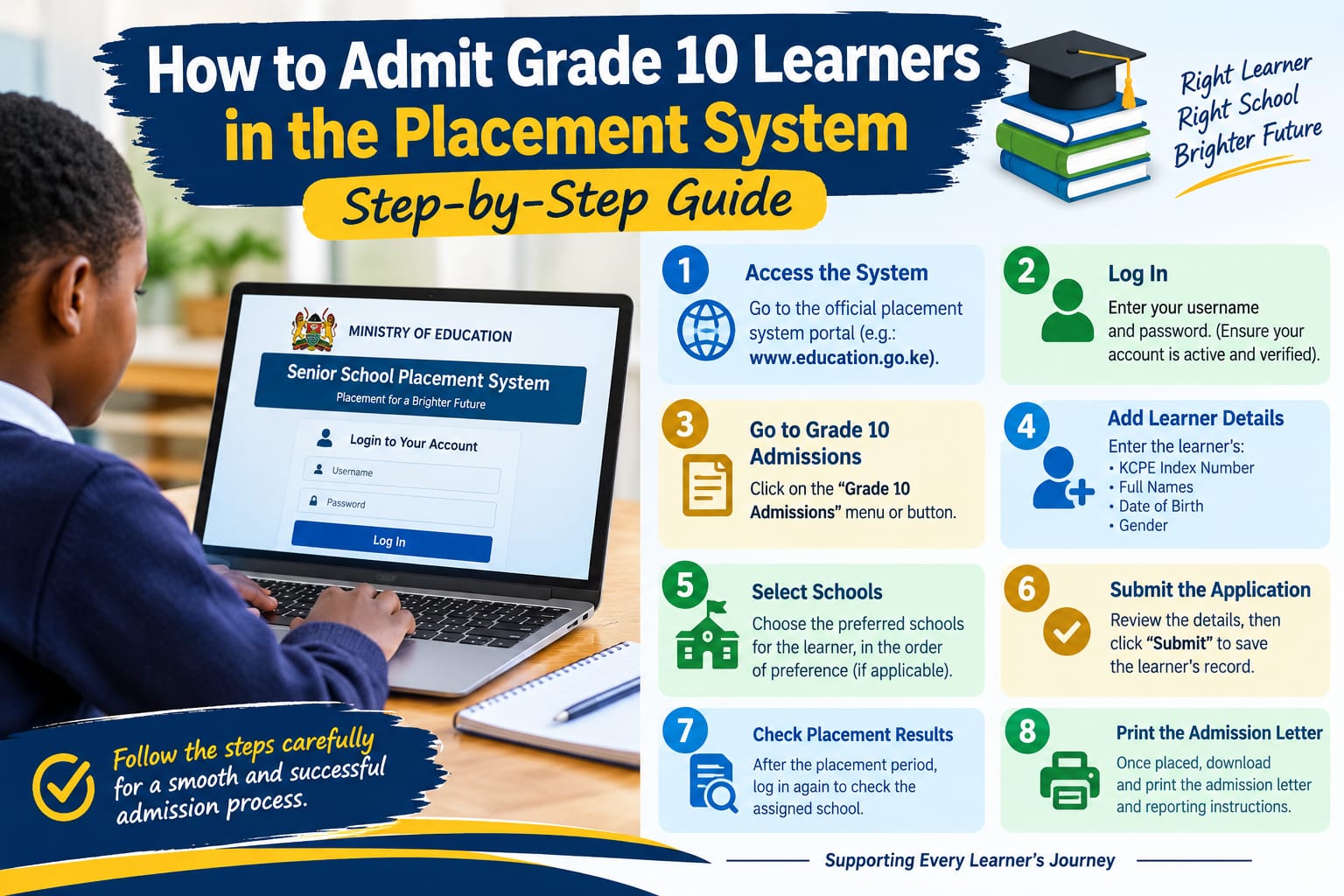
How to Admit Grade 10 Learners in the Placement System
Step 1: Access the Official Placement Portal
The first step is to access the official Grade 10 placement platform provided by the Ministry of Education.
School administrators should avoid using unofficial websites or links circulated through social media when accessing sensitive learner information.
Use the official government platform and ensure that the school’s account is authorised for admission activities.
Step 2: Log Into the School Account
Once the portal opens, select the login option.
The administrator should provide the required school credentials.
Depending on the current configuration of the portal, login information may include:
- Username
- UIC
- School KNEC code
- Password or other authentication information
Enter the details carefully.
If the login fails, verify the credentials rather than repeatedly entering incorrect information.
Step 3: Access the School Dashboard
After successful authentication, the administrator should access the school dashboard.
The dashboard may contain different options for managing placement and learner information.
Look for sections relating to:
- Grade 10 placement
- Learners
- Admissions
- Reporting
- Placement verification
- School records
The names and arrangement of menu options can change when the system is updated.
Step 4: View Learners Placed in the School
The school should access the list of learners who have been officially placed in the institution.
Administrators should carefully examine the available learner information.
Depending on the information displayed, schools may see details such as:
- Learner name
- Assessment number
- Junior School
- Placement school
- Pathway
- Track
- Subject combination
- Placement status
This list should form the basis for the school’s admission verification process.
Step 5: Verify the Learner’s Assessment Number
One of the most important details to verify is the learner’s assessment number.
Names alone should not be relied upon because two or more learners can have similar names.
The administrator should compare the learner’s assessment information with the information appearing in the placement system.
If there is a discrepancy, investigate it before proceeding.
Step 6: Confirm the Learner’s Placement
The school should establish whether the learner has actually been placed in the institution.
This is particularly important where a parent or learner arrives with a printed document, SMS or screenshot showing a preferred school.
The school should verify the information against the official placement records.
A learner’s preferred school and final placement may not always be the same.
Step 7: Confirm the Grade 10 Pathway
After verifying placement, the school should check the learner’s assigned pathway.
Senior school education provides different pathways, including:
STEM
Science, Technology, Engineering and Mathematics.
Social Sciences
This pathway covers areas related to humanities, social sciences, business and other related disciplines.
Arts and Sports Science
This pathway provides opportunities for learners interested in creative arts, performing arts and sports-related areas.
The receiving school should ensure that the learner’s programme corresponds with the official placement information.
Step 8: Check the Track and Subject Combination
The administrator should also confirm the relevant track and subject combination.
This is important because schools may offer different combinations depending on their:
- Staffing
- Infrastructure
- Equipment
- Facilities
- Approved programmes
- Learner capacity
Schools should avoid making informal programme changes simply because another class has available space.
Any changes should follow the applicable official procedures.
Step 9: Verify Reporting Documents
Before finalising admission, the school should check the documents required from the learner.
These may include:
- Grade 10 placement information
- Joining instructions
- Assessment information
- Birth certificate details where required
- Previous school information
- Medical forms
- Parent or guardian information
- Emergency contacts
- Other documents required by the school
Schools should communicate their requirements clearly to parents before reporting.
Step 10: Confirm the Learner’s Identity
The administrator should verify that the learner reporting to the school matches the learner listed in the placement records.
This is especially important when learners have similar names.
The school should use the available official learner information to minimise errors.
Proper identification helps prevent:
- Duplicate admission records
- Incorrect learner entries
- Identity confusion
- Wrong pathway allocation
Step 11: Confirm That the Learner Has Reported
Being placed in a school does not necessarily mean that the learner has reported.
A learner may appear on the school’s placement list but fail to report.
Schools should therefore distinguish between:
Placed learners and learners who have actually reported and completed admission.
This distinction is important when preparing accurate enrolment figures.
Step 12: Complete the Admission Process
Once the learner’s details, placement and documents have been verified, the authorised administrator can proceed with the appropriate admission or confirmation option available on the platform.
Before submitting the record, check:
- Learner name
- Assessment number
- Placement school
- Pathway
- Track
- Subject combination
- Reporting status
Careful verification at this stage can prevent future administrative problems.
Step 13: Confirm the Admission Status
After submitting the admission details, check whether the system displays a confirmation or updated learner status.
Where the platform provides a confirmation record, schools should retain it for administrative purposes.
The school should also ensure that the learner’s information is reflected correctly in its internal records.
Step 14: Complete School-Level Admission
Online admission should be followed by the school’s normal admission procedures.
The school may need to create or update an admission record containing information such as:
- Admission number
- Assessment number
- Learner’s full name
- Date of birth
- Previous school
- Parent/guardian contacts
- Pathway
- Track
- Subject combination
- Day or boarding status
- Emergency information
Schools should keep learner information secure and restrict access to authorised staff.
What If a Grade 10 Learner Is Missing From the School’s Placement List?
This is a common concern that schools and parents may encounter.
If a learner reports to a school but does not appear on its official placement list, administrators should not automatically create a manual admission.
Instead, the school should:
- Confirm the learner’s assessment number.
- Check the official placement record.
- Review the learner’s placement documentation.
- Establish whether the learner has been transferred.
- Check whether an approved replacement has taken place.
- Seek clarification through the appropriate official channels.
- Complete admission only after the placement issue has been resolved.
This helps protect the learner and school from inaccurate records.
What If the Parent Says the Learner Selected Your School?
A parent may say that the learner selected a particular school during Grade 10 selection.
That information alone does not necessarily confirm final placement.
The school should distinguish between:
School selected by learner
and
School officially assigned through placement.
Admission should be based on the appropriate official placement information.
Grade 10 Admission Checklist for Principals
Schools can use the following checklist during admission.
| Admission Item | Status |
|---|---|
| Learner appears on placement list | ✓ |
| Assessment number verified | ✓ |
| Learner identity confirmed | ✓ |
| Placement school confirmed | ✓ |
| Pathway confirmed | ✓ |
| Track confirmed | ✓ |
| Subject combination checked | ✓ |
| Reporting documents verified | ✓ |
| Parent/guardian information captured | ✓ |
| Medical information completed where required | ✓ |
| Admission record created | ✓ |
| Online admission confirmed | ✓ |
Common Grade 10 Admission Mistakes
Admitting a learner without verifying placement
Schools should verify placement before completing admission.
Confusing selection with placement
A learner’s preferred school is not necessarily the school appearing on the final placement record.
Using the learner’s name alone
Assessment numbers and other official information should also be checked.
Making unauthorised placement changes
Schools should follow the applicable procedures when dealing with transfers, replacements or corrections.
Ignoring pathway information
Learners should be admitted into the appropriate programme reflected in their placement information.
Failing to update school records
Online admission should be reconciled with the school’s internal admission records.
How Parents Can Prepare for Grade 10 Admission
Parents can make the reporting process easier by preparing the necessary documentation before the learner travels to school.
Parents should:
- Confirm the learner’s placement.
- Obtain the appropriate joining instructions.
- Check the reporting date.
- Prepare the required documents.
- Confirm the learner’s pathway.
- Keep the assessment information safely.
- Follow the school’s admission instructions.
- Seek clarification when official documents contain conflicting information.
Parents should also be cautious about relying on unofficial information circulated on social media.
Why Proper Grade 10 Admission Matters
Accurate admission information helps schools plan effectively.
Staffing
Accurate learner numbers help schools organise teaching and staffing requirements.
Classroom planning
Schools can organise classes and streams based on actual enrolment.
Infrastructure
Learner numbers influence planning for classrooms, laboratories, workshops, libraries, sanitation and other facilities.
Subject planning
Schools need accurate information about pathways, tracks and subject combinations.
Learner welfare
Correct parent, guardian and emergency information supports learner welfare and communication.
Grade 10 Admission FAQs
How do I admit Grade 10 learners in the placement system?
An authorised school administrator should log into the official Grade 10 placement platform, access learners placed in the school, verify their details and complete the available admission or confirmation procedure.
What details should a school verify before admission?
The school should verify the learner’s name, assessment number, placement school, pathway, track, subject combination and required reporting documents.
Can a school admit a learner who is not on its placement list?
The school should first establish the learner’s official placement and follow the applicable procedures for transfers, replacements or placement corrections.
Is Grade 10 selection the same as placement?
No. Selection involves indicating preferred schools and programmes, while placement is the process of assigning learners to senior schools.
What should a school do if the placement information is incorrect?
The school should verify the learner’s details and seek clarification through the appropriate official education channels instead of making an unauthorised change.
Does being placed mean that a learner has been admitted?
Not necessarily. A learner must report to the school and complete the applicable verification and admission procedures.
What happens after Grade 10 admission?
The school should update its internal learner records, organise the learner according to the appropriate pathway and programme, and complete other school-level reporting requirements.
Final Takeaway
The Grade 10 admission process requires careful verification and accurate record keeping. Schools should not rely solely on a learner’s preferred school, a screenshot or an informal message when confirming admission.
The practical workflow is:
Access portal → Login → View placed learners → Verify assessment number → Confirm placement → Check pathway → Verify track and subjects → Check documents → Confirm reporting → Complete admission → Update school records.
As the Ministry of Education continues to implement and refine the senior school transition process, schools should always follow the latest official instructions and system requirements displayed on the authorised Grade 10 placement platform.