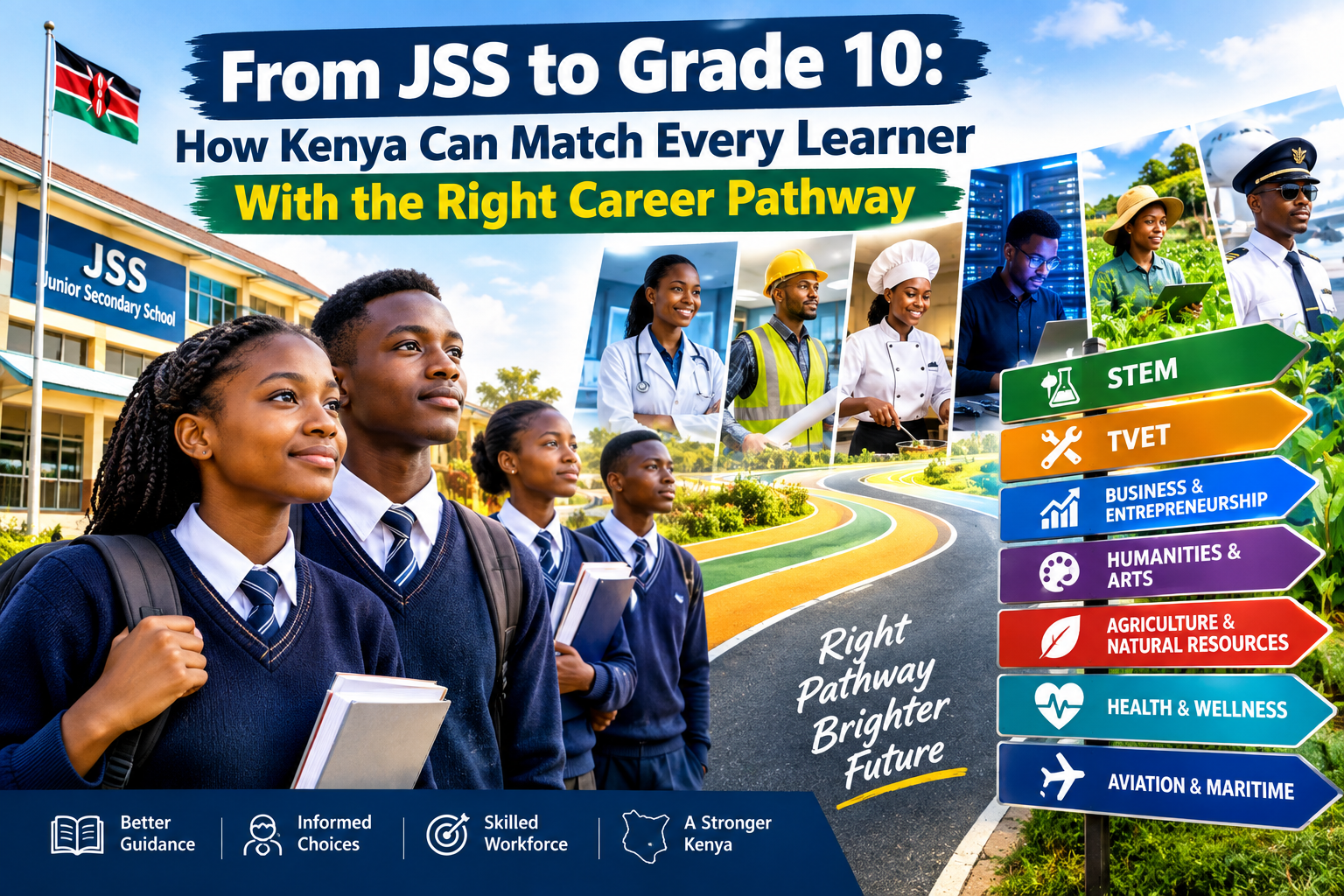
The transition from Junior Secondary School (JSS) to Grade 10 is changing the way Kenyan learners, parents and teachers think about secondary education.
For decades, academic examination results played a major role in determining what happened after primary and secondary school. Under the Competency-Based Education (CBE) approach, however, the conversation is becoming broader.
The question is no longer simply:
“How many marks did the learner get?”
The more important question is:
“What can this learner do, what does the learner enjoy, and which pathway can help develop those abilities?”
This shift is particularly important as learners move toward Senior School, where they are expected to pursue areas of learning connected to their interests, abilities and future aspirations.
The Kenya Institute of Curriculum Development (KICD) has developed Grade 10 curriculum designs covering a wide range of areas, including sciences, humanities, languages, technical studies, religious education, arts and sports.
This creates an opportunity to move away from the idea that every learner must follow the same educational route.
Why the Grade 10 Transition Matters
Grade 10 is an important stage because learners begin taking more deliberate steps toward areas they may want to pursue in further education, training and employment.
A learner interested in engineering may require a different combination of subjects from a learner interested in journalism.
A talented athlete may require opportunities that are different from those needed by a learner interested in pure sciences.
A learner interested in business may benefit from a different combination of learning experiences.
This is why the transition should not be treated as simply moving from one school to another.
It is a transition from general learning toward more focused learning.
The Problem With the “One Grade Decides Everything” Approach
One of the biggest concerns parents have about educational assessment is the possibility of reducing a learner’s future to a single result.
A grade can tell us something about performance.
But it cannot necessarily tell us everything about:
- Creativity
- Leadership
- Practical ability
- Sporting talent
- Artistic ability
- Communication skills
- Problem-solving
- Entrepreneurship
- Personal interests
- Career aspirations
A learner may perform moderately in a written assessment but demonstrate exceptional practical ability.
Another learner may excel academically but have a strong interest in music, sport or creative work.
The challenge for the education system is therefore to ensure that assessment provides useful evidence without becoming a permanent label.
The New Question Parents Should Ask
Instead of asking:
“Which school has the highest marks?”
parents preparing for Grade 10 should consider asking:
“Which school can support my child’s pathway?”
That question changes the entire school-selection process.
Parents should investigate:
- The learner’s strengths
- The learner’s interests
- The preferred career areas
- Available pathways
- Subject combinations
- School facilities
- Co-curricular opportunities
- Location
- Cost
- Learner support
Understanding the Three Broad Pathways
Senior School is generally organized around three broad pathways:
1. STEM
STEM covers Science, Technology, Engineering and Mathematics-related areas.
It can be relevant to learners interested in fields such as:
- Engineering
- Medicine
- Computer science
- Information technology
- Agriculture
- Architecture
- Laboratory sciences
- Mathematics
- Technical careers
A learner considering STEM should investigate schools with appropriate laboratories, ICT resources and relevant subject combinations.
2. Social Sciences
Social Sciences provide opportunities in areas associated with subjects such as humanities, languages and business-related studies.
Potential career areas include:
- Law
- Business
- Communication
- Education
- Economics
- Journalism
- Public administration
- Languages
- Social research
The important point is that Social Sciences should not be viewed as a pathway for learners who “failed” to qualify for STEM.
It represents a different area of learning with its own opportunities.
3. Arts and Sports Science
This pathway provides opportunities for learners interested in:
- Music
- Drama
- Dance
- Visual arts
- Sports
- Creative industries
KICD’s Grade 10 curriculum materials include Arts & Sports among the curriculum areas available for Senior School.
A learner with significant sporting or creative talent should therefore be encouraged to explore opportunities that can develop that talent.
Career Guidance Should Start Before Grade 10
Career guidance should not begin when learners are already reporting to Senior School.
It should start earlier.
During JSS, learners can be encouraged to explore:
- What subjects they enjoy
- What activities they perform well in
- What problems they enjoy solving
- What careers interest them
- What talents they possess
- What skills they want to develop
This information can help create a clearer picture of possible future directions.
Teachers Have a Major Role
Teachers spend considerable time observing learners.
They may notice things that examination results do not fully capture.
For example, a teacher may observe that a learner:
- Solves practical problems quickly
- Has excellent communication skills
- Shows leadership during group work
- Performs exceptionally in sports
- Demonstrates creativity
- Enjoys scientific experiments
- Has strong interest in computers
Such observations can contribute to career guidance.
Teachers should not decide a learner’s future for them.
Instead, they can provide information and guidance that helps learners make informed choices.
Parents Should Avoid Imposing Careers
Parents naturally want successful futures for their children.
However, success can take many forms.
A parent may want a child to become a doctor while the child has a strong interest in engineering.
Another parent may prefer a traditional academic career while the learner demonstrates exceptional artistic ability.
The best conversations should therefore involve:
Parent + learner + teacher/career guidance + assessment evidence.
This allows different perspectives to be considered.
School Selection Should Follow Pathway Selection
A common mistake is choosing a school first and then thinking about the pathway.
A more logical process is:
Identify interests → explore pathway → identify subjects → find suitable schools.
For example, if a learner wants to pursue a particular STEM area, the family should first understand the relevant subjects and then identify schools offering those subjects.
Likewise, a learner interested in sports should investigate whether shortlisted schools have the facilities and programmes required.
Why Subject Combinations Matter
Choosing a pathway is only the beginning.
The actual subject combination is also important.
Two learners may both select STEM but follow different subject combinations.
Similarly, two learners interested in Social Sciences may have different academic interests.
Parents should therefore ask schools:
“Which Grade 10 subject combinations are available?”
This question can prevent disappointment later.
School Facilities Matter More Than Ever
The CBE approach makes facilities particularly relevant because different pathways require different learning environments.
STEM facilities
Parents can look for:
- Laboratories
- ICT facilities
- Workshops
- Science equipment
- Mathematics resources
Arts facilities
Consider:
- Music rooms
- Art spaces
- Performance areas
- Drama facilities
- Creative resources
Sports facilities
Consider:
- Playing fields
- Courts
- Athletics facilities
- Equipment
- Qualified coaching and support
The right facility can help transform a learner’s interest into a practical skill.
The Role of Assessment in Pathway Selection
Assessment should answer several questions.
What has the learner learned?
This measures academic achievement.
What can the learner do?
This considers demonstrated competencies.
Where does the learner need support?
This identifies learning gaps.
What does the learner enjoy?
This considers interests.
What talents are emerging?
This helps identify areas requiring further development.
The combination provides a richer picture than a single score.
Why Flexibility Is Important
Career decisions made at 14 or 15 should not necessarily be treated as permanent.
Young people continue developing.
A learner may discover a new interest after joining a school club.
Another may become interested in technology after learning coding.
Another may discover a talent in athletics.
Another may develop an interest in business.
Education should therefore provide guidance while recognizing that learners can continue developing their interests and abilities.
The “Right Pathway” Is Different for Every Learner
There is no universal pathway that is appropriate for everyone.
For one learner, STEM may align with strong interest in science and technology.
For another, Social Sciences may better match interests in business, languages or communication.
For another, Arts and Sports Science may provide opportunities to develop creative or sporting talent.
The important principle is fit, rather than prestige.
How Schools Can Improve Career Guidance
Senior schools can help families by providing clear information about:
- Pathways
- Subjects
- Facilities
- Career guidance
- Co-curricular activities
- Admission requirements
- Learning support
- Progression opportunities
Schools should make this information accessible before parents make their final decisions.
A Simple Career Pathway Checklist for Parents
Before choosing a Grade 10 school, parents can use this checklist.
Learner
- What does the learner enjoy?
- What are the learner’s strongest areas?
- What talents have teachers identified?
- What careers interest the learner?
Pathway
- Which pathway fits those interests?
- What subjects are required?
- Does the learner understand the pathway?
School
- Does the school offer the pathway?
- Does it offer the required subjects?
- Are the necessary facilities available?
- Is it affordable?
- Is the location practical?
Support
- Does the school offer career guidance?
- How does it support learners who struggle?
- What opportunities exist outside the classroom?
A Better Model for Grade 10 Selection
The future of JSS transition can be viewed as a six-stage process.
Stage 1: Discover
Identify learner interests and talents.
Stage 2: Assess
Examine academic achievement and competency evidence.
Stage 3: Guide
Provide career information and counselling.
Stage 4: Explore
Compare possible pathways and subjects.
Stage 5: Select
Choose appropriate Senior School options.
Stage 6: Develop
Continue supporting the learner after Grade 10.
This model recognizes that career development is a journey rather than a single examination event.
What Learners Should Do
Learners should take responsibility for understanding themselves.
They can:
- Ask questions about careers
- Explore different subjects
- Participate in clubs
- Develop practical skills
- Discuss their interests with teachers
- Research career requirements
- Talk to parents
- Keep records of achievements
The learner should be an active participant in pathway selection.
What Parents Should Not Do
Parents should avoid:
- Choosing a pathway purely because it is fashionable
- Selecting a school only because of its reputation
- Comparing children unfairly
- Treating one grade as a permanent label
- Ignoring the learner’s interests
- Assuming every child should follow the same career
- Spending beyond their financial capacity simply to access a particular school
The objective should be to create an environment where the learner can develop.
What Teachers Should Not Do
Teachers should also avoid telling learners:
“You are only suitable for this career.”
Career guidance should open possibilities rather than close them.
Teachers can explain evidence and options, but learners and families need space to make informed decisions.
The Future of Career Guidance in Kenya
The success of the JSS-to-Senior-School transition will depend partly on how effectively Kenya connects:
Assessment + Career Guidance + Pathways + Subjects + Schools.
If these elements work together, learners can receive more meaningful guidance.
If they operate separately, parents may continue experiencing confusion.
Frequently Asked Questions
What happens after Junior Secondary School?
Learners transition to Senior School at Grade 10, where they pursue learning within the available pathways and subject combinations.
What are the main Senior School pathways?
The broad pathways are STEM, Social Sciences, and Arts and Sports Science.
Does a learner’s grade determine their career?
No single grade should be treated as a complete description of a learner’s abilities or future. Assessment is one source of evidence among several factors.
Should parents choose schools based on academic results?
Academic results can provide useful historical information, but parents should also consider pathways, subjects, facilities, learner interests and support systems.
Can a learner change career interests?
Yes. Young people’s interests and aspirations can develop as they gain new experiences.
Why is career guidance important?
Career guidance helps learners understand their strengths, explore opportunities and make more informed educational choices.
Conclusion
The JSS-to-Grade 10 transition presents Kenya with an opportunity to rethink how young people are guided toward their futures.
The central issue should not be whether one pathway is more important than another.
The important question is whether each learner can access an educational pathway that develops their abilities, interests and aspirations.
A strong transition system should bring together assessment, career guidance, learner interests, subject choices and school opportunities.
For parents, the message is simple:
Do not begin with the school. Begin with the learner.
Understand the learner’s strengths.
Explore the learner’s interests.
Understand the pathways.
Check the subjects.
Then identify schools that can provide the right learning environment.
That approach can make the move from JSS to Grade 10 more informed and help ensure that Senior School becomes a place where different kinds of Kenyan talent can grow.