Introduction
The transition from Junior School to Senior School is one of the most important stages in Kenya’s Competency-Based Education journey.
As learners prepare to enter Grade 10, they are required to make choices concerning senior schools, pathways, tracks and subject combinations. These choices form part of the broader transition process that eventually leads to placement in Senior School.
For parents, learners and teachers, it is important to understand that selection and placement are two different stages.
A learner may select a particular school, but that does not necessarily mean the learner will finally be placed there. Placement takes place after the selection process and is guided by the applicable Ministry of Education procedures and available spaces.
This guide explains the Grade 10 selection and placement process from beginning to end.
What Is Grade 10 Selection?
Grade 10 selection is the process through which learners indicate their preferred Senior Schools and learning programmes.
During selection, learners make choices based on factors such as:
- Preferred senior schools
- CBE pathways
- Tracks
- Subject combinations
- Learner interests
- Abilities and talents
- Available school programmes
The selection process is therefore an important opportunity for learners to express their educational preferences.
However, selection should not be confused with final placement.
What Is Grade 10 Placement?
Placement is the subsequent process through which learners are assigned to Senior Schools.
The final placement may depend on several factors, including:
- Learner choices
- Performance and assessment information
- Available spaces
- School capacity
- Programme availability
- Applicable placement criteria
- Gender considerations where applicable
- Other official requirements
The school a learner eventually joins is therefore determined through the official placement process rather than simply by the learner’s first choice.
Grade 10 Selection vs Placement
| Selection | Placement |
|---|---|
| Learner indicates preferred schools | Learner is assigned to a school |
| Takes place before placement | Takes place after selection |
| Includes pathway/programme choices | Produces an official placement |
| Expresses learner preference | Determines the receiving school |
| Does not guarantee admission | Provides the basis for reporting |
The simplest way to remember the process is:
Choose → Submit → Placement → Check Results → Report → Admission
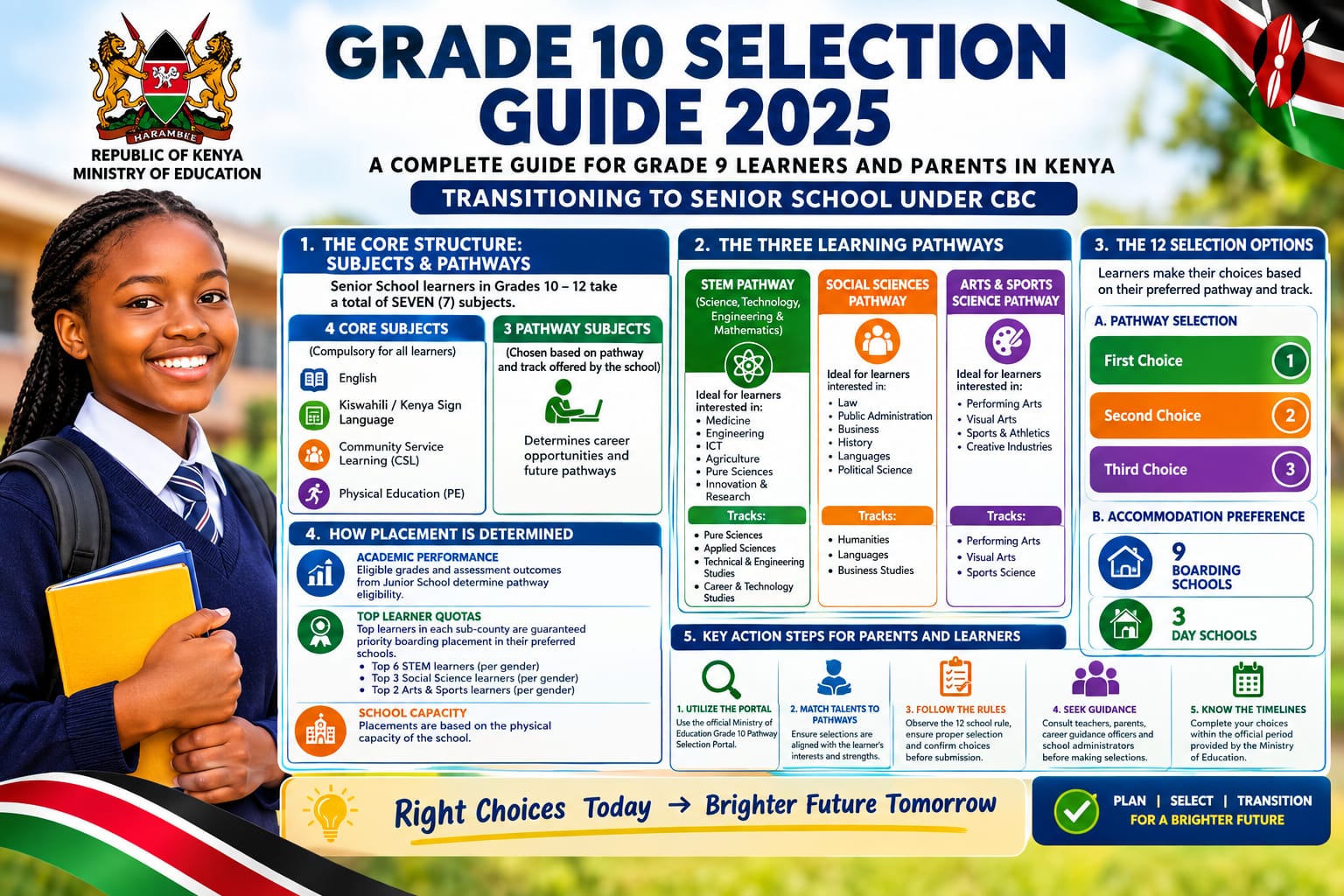
Step 1: Understand the Senior School Pathways
Before selecting schools, learners and parents should understand the available pathways.
The main Senior School pathways are:
STEM
Science, Technology, Engineering and Mathematics
This pathway is suitable for learners interested in scientific, mathematical, technological and technical areas.
Social Sciences
This pathway provides learning opportunities in areas related to humanities, social sciences, business and related disciplines.
Arts and Sports Science
This pathway provides opportunities for learners with interests and abilities in creative arts, performing arts and sports.
Step 2: Identify the Learner’s Interests and Strengths
School selection should begin with the learner.
Parents and teachers can help learners consider:
- Subjects they enjoy
- Areas where they demonstrate ability
- Practical skills
- Creative talents
- Sporting abilities
- Career interests
- Learning preferences
The objective should be to make an informed choice rather than selecting a school simply because it is famous or located in a particular county.
Step 3: Research Available Senior Schools
Before submitting choices, learners and parents should investigate the schools available to them.
Important factors include:
- School category
- Location
- Pathways offered
- Tracks available
- Subject combinations
- Boarding or day status
- Infrastructure
- Laboratories and workshops
- Sports facilities
- Arts facilities
- School capacity
- Accessibility
A school may have an excellent reputation but not offer the particular programme a learner wants.
Step 4: Check the Pathways Offered by Each School
This is a crucial part of Grade 10 selection.
Do not select a school without first checking whether it offers the learner’s preferred pathway and programme.
For example, a learner interested in a particular STEM combination should select schools capable of offering that programme.
Likewise, a learner interested in Arts and Sports Science should identify schools with the relevant facilities and approved programmes.
Step 5: Consider Subject Combinations
Subject combinations are another important part of the selection process.
Learners should carefully examine the subjects available under their preferred pathway.
Parents and teachers can help learners understand how particular subject combinations relate to future learning opportunities.
However, learners should avoid choosing subjects simply because friends are selecting them.
Step 6: Make the Required School Choices
During the official selection exercise, learners submit their preferred schools according to the number and categories allowed by the current Ministry guidelines.
The choices should be entered carefully.
Before submitting, check:
- School name
- School code
- Pathway
- Track
- Subject combination
- Order of preference
An error in school selection can create confusion later.
Step 7: Review the Selection Before Submission
Before final submission, carefully review all information.
Check that:
Learner details + school choices + pathway + subject combination = correct information
Parents and teachers assisting learners should take time to confirm the entries before the selection is submitted.
Step 8: Submit the Selection
Once all information has been verified, the learner’s selection can be submitted through the official platform during the designated selection period.
Keep any confirmation information generated by the system.
It can be useful when checking the learner’s selection later.
Step 9: Wait for the Placement Process
After selection closes, the placement process takes place.
At this stage, learners and parents should understand that the final school is not determined solely by preference order.
Placement takes account of the applicable official criteria and available opportunities.
Step 10: Check Grade 10 Placement Results
Once placement results are released, learners and parents should check the official placement information.
The learner should verify:
- Name
- Assessment number
- Junior School details
- Placed Senior School
- Pathway
- Track
- Subject combination
- Other relevant information
Parents should rely on official Ministry channels when checking placement results.
Step 11: Download or Obtain Joining Instructions
After placement, the learner should obtain the relevant joining instructions from the receiving school or official platform, depending on the procedure in place.
Joining instructions normally provide important information about:
- Reporting date
- Required documents
- Uniform
- Personal effects
- Fees or approved charges where applicable
- Medical information
- School requirements
- Other reporting instructions
Parents should read the instructions carefully.
Step 12: Report to the Placed School
The learner should report to the Senior School assigned through the official placement process.
Parents should ensure the learner arrives with the required documentation.
The school will then verify the learner’s placement and complete its admission procedures.
Step 13: School Verifies the Learner
The receiving school should confirm:
- Learner identity
- Assessment number
- Placement status
- Pathway
- Track
- Subject combination
- Reporting information
- Required documents
This verification helps prevent incorrect admissions.
Step 14: Complete Grade 10 Admission
Once placement and learner details have been verified, the school completes the relevant admission process.
The learner can then be entered into the school’s internal records and assigned to the appropriate class, pathway and programme.
What Happens If a Learner Does Not Get the First-Choice School?
A learner may not necessarily be placed in the first school selected.
This does not mean the selection process has failed.
Placement involves matching learners with available opportunities according to the applicable criteria.
The learner should first check the official placement result and the programme offered by the assigned school.
Where the Ministry provides an official review, transfer or placement-change mechanism, parents should follow that process rather than attempting an informal change directly through the school.
Can a Learner Change the School After Placement?
A placement change should be handled through the official process applicable at the time.
Parents should not assume that simply visiting another school automatically changes a learner’s placement.
Before making any decision, confirm:
- Whether the school has available space.
- Whether the desired pathway is offered.
- Whether the learner qualifies under the applicable requirements.
- Whether the official transfer/review process is open.
- Whether approval has been granted.
Factors Parents Should Consider When Choosing Grade 10 Schools
School Programme
Does the school offer the pathway and subject combination the learner wants?
Location
Consider distance from home and transport arrangements.
Facilities
Check whether the school has the facilities needed for the chosen programme.
Learner’s Interests
The learner’s abilities and interests should be considered.
School Environment
Parents should consider the school’s learning environment, discipline structures, welfare arrangements and support systems.
Boarding or Day
Families should consider whether boarding or day schooling is appropriate and available.
Common Grade 10 Selection Mistakes
Choosing a school because it is popular
Popularity alone does not determine whether a school is appropriate for a particular learner.
Ignoring pathways
A school may not offer the pathway or combination selected by the learner.
Selecting without researching
Parents and learners should understand the programmes offered before submitting choices.
Assuming first choice means guaranteed placement
A preference is not the same as a final placement.
Entering incorrect school information
Learners should carefully verify school names and codes before submission.
Following social media rumours
Placement information should be obtained from official sources.
Grade 10 Selection Checklist
Before submitting choices, ask:
- Have we identified the learner’s interests?
- Have we considered the learner’s strengths?
- Have we researched the selected schools?
- Does each school offer the preferred pathway?
- Is the required track available?
- Are the subject combinations suitable?
- Have school codes been checked?
- Have learner details been verified?
- Has the selection been reviewed before submission?
- Has confirmation been saved?
Grade 10 Selection and Placement Timeline
The exact dates should always be confirmed through official Ministry announcements.
The general sequence is:
Junior School → Assessment → Selection → Placement → Placement Results → Joining Instructions → Reporting → Admission → Senior School Learning
Because official dates can change, parents should avoid relying on old calendars circulating online.
Frequently Asked Questions
What is Grade 10 selection?
Grade 10 selection is the process through which learners indicate preferred Senior Schools, pathways, tracks and subject combinations.
What is Grade 10 placement?
Placement is the process through which learners are assigned to Senior Schools after the selection exercise.
Does selecting a school guarantee placement?
No. Selection expresses preference, while final placement is determined through the applicable official placement process.
How many schools can a learner select?
The number and categories of choices should be confirmed from the official Ministry guidelines applicable to the relevant selection cycle.
Can parents choose a Grade 10 school for their child?
Parents can guide and support learners, but the learner’s interests, abilities and programme requirements should be considered when making choices.
What are the main Senior School pathways?
The main pathways are STEM, Social Sciences, and Arts and Sports Science.
What happens after Grade 10 placement?
The learner checks the placement result, obtains joining information, reports to the assigned school and completes the school’s admission process.
What should I do if the learner is placed in a different school?
First verify the official placement. If the family wishes to request a change, follow the official placement review or transfer procedure available at that time.
Final Thoughts
Grade 10 selection and placement are important stages in Kenya’s transition to Senior School under Competency-Based Education.
The most important thing for parents and learners to remember is that selection is a choice, while placement is an assignment.
A good selection process starts with understanding the learner’s interests and abilities, researching available Senior Schools, checking pathways and subject combinations and carefully submitting the required choices.
After selection, learners and parents should wait for the official placement outcome and use that information when preparing for reporting and admission.
The complete journey can be summarised as:
Understand pathways → Identify learner interests → Research schools → Choose programmes → Submit selections → Placement → Check results → Obtain joining instructions → Report → Admission.
Parents and learners should always check the latest official Ministry of Education instructions for dates, requirements, school choices, placement criteria and any available review or transfer procedures.