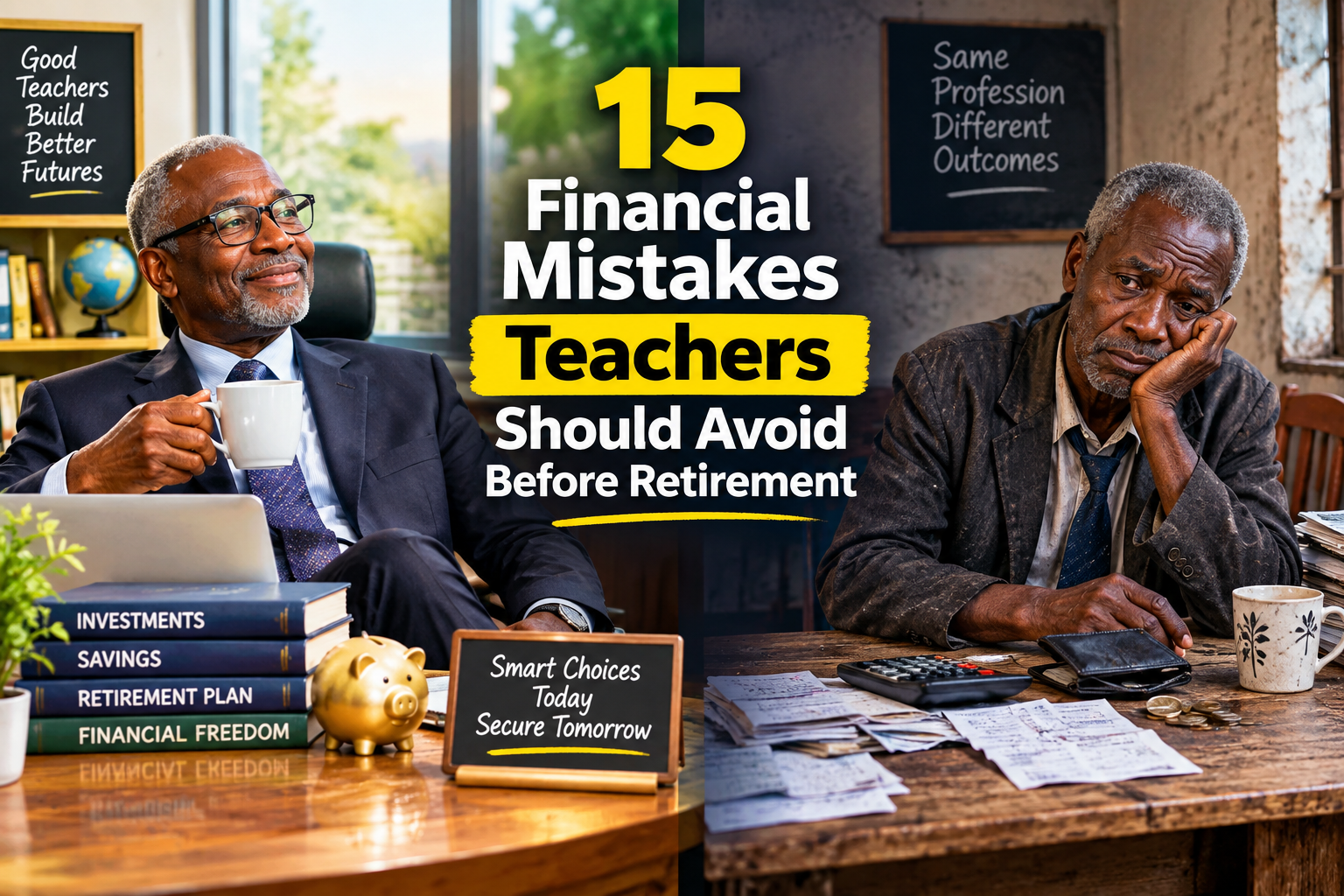
15 Financial Mistakes Teachers Should Avoid Before Retirement
1. Depending Entirely on the Monthly Salary
One of the biggest financial risks is depending entirely on employment income.
During employment, a teacher knows that a salary will generally arrive every month. This can create a false sense of financial security.
However, retirement changes the income equation.
The salary that supported rent, food, transport, school fees, loans and other expenses may no longer be available in the same form.
Teachers should therefore use their working years to build savings and assets that can supplement retirement income.
What teachers can do
Start developing financial sources outside the monthly salary.
Depending on individual circumstances, these could include:
- Savings
- Pension and retirement benefits
- Rental property
- Agriculture
- A carefully managed business
- Government securities
- Regulated investment products
- SACCO savings
- Other legitimate income-producing assets
The objective is to gradually reduce dependence on one source of income.
2. Taking Too Many Salary Loans
Loans can be useful when used responsibly, but excessive borrowing can become one of the biggest obstacles to financial independence.
A teacher may take a loan for a house, education, business, vehicle, emergency or household expenses. Over time, multiple loans can create a situation where a large portion of monthly income goes directly toward debt repayment.
This becomes particularly dangerous when borrowing is used to finance consumption rather than productive assets.
Before taking a loan, ask:
- What exactly will this money accomplish?
- Is the loan necessary?
- How much will I repay in total?
- Can I comfortably afford the monthly repayment?
- Will the loan create an asset or income?
- What happens if my financial circumstances change?
Borrowing should be treated as a financial decision rather than an automatic solution to every financial problem.
3. Retiring With Large Outstanding Debts
Taking loans is one issue. Reaching retirement with substantial outstanding debt is another.
A retiree who still has major loan obligations may have limited funds available for daily living.
Teachers should therefore develop a debt-reduction plan well before retirement.
This does not necessarily mean avoiding all borrowing. Instead, the objective should be to ensure that major debts are manageable and that retirement income is not overwhelmed by repayments.
A practical approach
List every debt and record:
- Outstanding balance
- Interest rate
- Monthly repayment
- Remaining repayment period
- Purpose of the loan
Then prioritize expensive or problematic debts while continuing to meet required payments on others.
4. Increasing Lifestyle Expenses Whenever Income Rises
Salary increases can improve a teacher’s standard of living, but they can also create a financial trap.
When income increases, some people immediately increase spending.
They may move to a more expensive house, purchase a more expensive vehicle, increase entertainment expenses or take on additional financial commitments.
This is known as lifestyle inflation.
The danger is that income can rise without wealth increasing significantly.
A better approach
Whenever your income increases, consider dividing the additional money among:
- Savings
- Investments
- Debt repayment
- Essential expenses
- A reasonable improvement in lifestyle
Not every salary increase needs to become a permanent increase in monthly expenses.
5. Delaying Investment Until Near Retirement
Time is one of the most valuable resources in financial planning.
A teacher who starts saving and investing early has more time to build wealth than someone who begins shortly before retirement.
This is because long-term investment growth can benefit from compounding.
For example, consistently investing a manageable amount over many years can potentially produce a much larger financial base than attempting to invest a very large amount during the final years of employment.
The exact results depend on the investment, returns, fees, taxes and consistency.
The lesson
Do not wait until retirement is approaching before asking:
“What will I live on after retirement?”
Start planning early.
6. Spending Retirement Benefits Without a Long-Term Plan
Retirement benefits can represent decades of contributions and disciplined employment.
Receiving a substantial lump sum can create a temptation to spend quickly.
Some retirees may use large amounts of retirement money on:
- Expensive vehicles
- Large celebrations
- Unplanned businesses
- Supporting relatives
- Construction projects without a financial plan
- Consumer purchases
- Paying for other people’s expenses
Once the money is spent, replacing it can be difficult.
Before spending retirement benefits, consider:
- Existing debts
- Housing needs
- Healthcare costs
- Emergency reserves
- Monthly income requirements
- Dependants
- Investment opportunities
- Tax implications
- Professional financial advice where appropriate
Retirement money should be treated as a long-term resource rather than a sudden windfall.
7. Buying Cars That Are Too Expensive to Maintain
A vehicle can be useful, especially for a retired teacher living in a rural or semi-urban area.
However, buying a vehicle that is too expensive can place significant pressure on retirement finances.
The purchase price is only one part of the cost.
There are also:
- Fuel
- Insurance
- Repairs
- Servicing
- Tyres
- Licensing and other expenses
- Depreciation
A teacher approaching retirement should consider whether the vehicle will improve their financial position or simply increase expenses.
A reliable and affordable vehicle may be more practical than an expensive model that consumes a large portion of savings.
8. Building Houses Without Considering Cash Flow
Property can be an important part of a retirement strategy, but construction does not automatically create financial security.
A teacher may spend years building a large house without considering whether it will generate income.
There is an important difference between:
A house that you live in
and
an income-producing property.
Both can be valuable, but they serve different financial purposes.
Teachers considering property investment should think about location, demand, construction costs, maintenance, rental income and financing before committing substantial funds.
9. Investing in Businesses Without Adequate Knowledge
Starting a business can create an additional income stream, but business ownership also carries risks.
Some teachers enter businesses because friends or relatives claim that the business is highly profitable.
This can lead to losses when the investor does not understand:
- Customers
- Competition
- Cash flow
- Stock management
- Operating costs
- Taxes
- Business risks
- Record keeping
Teachers should avoid putting retirement savings into businesses simply because someone promises high returns.
Research and proper management matter.
10. Supporting Everyone Financially
Teachers are often viewed as stable earners within families and communities.
As a result, relatives may turn to them for financial assistance.
Helping family members is a personal decision, but unlimited financial support can make retirement planning extremely difficult.
A teacher may simultaneously pay:
- Children’s school fees
- Relatives’ medical bills
- Family construction projects
- Household expenses
- Emergency contributions
- Other family obligations
If these responsibilities consume most available income, saving and investing become difficult.
A healthier approach
Set a realistic family-support budget.
Helping others should not require destroying your own long-term financial security.
11. Paying Children’s Expenses Without Planning for Independence
Parents naturally want to provide opportunities for their children.
However, there is a point where financial support can become unsustainable.
Teachers may continue paying for adult children’s expenses long after they have entered employment or adulthood.
This can put pressure on retirement savings.
Parents should gradually teach children:
- Budgeting
- Saving
- Responsible borrowing
- Investing
- Entrepreneurship
- Financial independence
Preparing children to manage money can ultimately be more valuable than continuously financing every expense.
12. Ignoring Healthcare Planning
Healthcare is one of the most important retirement considerations.
As people age, medical expenses can become a significant part of household expenditure.
A teacher who has saved for retirement but has not planned for healthcare risks using retirement funds to meet unexpected medical costs.
Teachers should understand their available health insurance and retirement healthcare arrangements and maintain appropriate emergency savings.
Healthcare planning should form part of retirement planning—not something considered only after retirement.
13. Failing to Build an Emergency Fund
Investments are important, but teachers should also have accessible savings for emergencies.
Unexpected events can include:
- Medical emergencies
- Urgent family needs
- Major home repairs
- Vehicle repairs
- Temporary income disruption
- Other unexpected expenses
Without an emergency fund, a teacher may be forced to borrow whenever an unexpected expense appears.
A dedicated emergency reserve can reduce dependence on expensive short-term borrowing.
14. Not Tracking Where the Money Goes
A teacher can earn a reasonable income and still have little to show for it if spending is not monitored.
Without a budget, small expenses can quietly consume significant amounts of money.
Examples include:
- Eating out frequently
- Impulse shopping
- Unnecessary subscriptions
- Excessive entertainment
- Frequent mobile-money transfers
- Unplanned travel
- Repeated borrowing and lending
A simple monthly budget can reveal where money is actually going.
A basic teacher’s budget could include:
| Category | Purpose |
|---|---|
| Housing | Rent or mortgage |
| Food | Household consumption |
| Transport | Work and personal travel |
| Education | Children’s education |
| Debt | Loan repayments |
| Savings | Emergency and long-term savings |
| Investments | Wealth creation |
| Healthcare | Insurance and medical needs |
| Family support | Planned assistance |
| Personal spending | Recreation and other expenses |
The percentages will vary from teacher to teacher.
The important principle is to give every shilling a purpose.
15. Assuming Pension Alone Will Solve Everything
One of the most dangerous retirement assumptions is:
“I have a pension, so I will be fine.”
Retirement benefits are important, but they may not cover every financial need.
Retirement planning should consider:
- Expected retirement income
- Housing
- Food
- Healthcare
- Transportation
- Family support
- Inflation
- Emergencies
- Personal goals
- Existing debts
Teachers should understand their expected retirement benefits and compare them with their projected expenses.
This allows them to identify financial gaps while there is still time to address them.
How Teachers Can Prepare for a Better Retirement
Retirement preparation does not need to begin when someone is 55 or 60.
It can start with small decisions made early in a career.
1. Start Saving Early
Even modest, consistent savings can become meaningful over a long period.
The key is consistency.
Instead of saving only what remains after spending, consider treating saving as one of the first monthly financial commitments.
2. Control Debt
Borrowing should have a clear purpose.
Teachers should distinguish between:
productive debt — borrowing that may help create an asset or income,
and
consumption debt — borrowing mainly to finance spending that does not generate future income.
The distinction is not absolute, but it is useful when evaluating financial decisions.
3. Invest Gradually
Investment decisions should match an individual’s:
- Goals
- Time horizon
- Risk tolerance
- Income
- Existing assets
- Knowledge
Teachers should also verify that investment providers are properly regulated where applicable and be cautious about promises of unusually high or guaranteed returns.
4. Build Income-Producing Assets
A strong retirement strategy can involve assets capable of generating income.
Depending on personal circumstances, these might include:
- Rental property
- Agriculture
- Businesses
- Savings products
- Government securities
- Regulated collective investment products
- Other diversified investments
The goal is not to copy another person’s investment strategy.
What works for one teacher may not work for another.
Retirement Planning by Career Stage
Early-Career Teachers
Teachers in the early stages of employment have one major advantage: time.
This is the period to develop good financial habits.
Focus on:
- Building an emergency fund
- Avoiding unnecessary debt
- Starting long-term investments
- Developing financial literacy
- Controlling lifestyle inflation
- Acquiring useful skills
Mid-Career Teachers
This can be an important wealth-building stage.
Teachers may have higher income and greater financial responsibilities.
Focus on:
- Reducing expensive debt
- Increasing savings
- Building productive assets
- Reviewing insurance
- Planning children’s education
- Diversifying income
- Reviewing retirement projections
Teachers Approaching Retirement
At this stage, financial planning becomes more urgent.
Focus on:
- Clearing or reducing major debts
- Understanding retirement benefits
- Estimating monthly retirement expenses
- Reviewing investments
- Planning healthcare
- Preparing housing arrangements
- Creating a post-retirement income plan
Avoid making high-risk financial decisions simply because retirement is approaching.
Common Retirement Myths Teachers Should Avoid
Myth 1: “I will start saving after my salary increases.”
Salary increases can help, but waiting for a higher income may simply result in higher expenses.
Myth 2: “My pension will be enough.”
It may provide an important source of retirement income, but individual needs differ.
Myth 3: “Owning a big house means I am financially secure.”
A home can provide housing security, but it may not generate cash flow.
Myth 4: “A new car means I have succeeded.”
A vehicle is generally a depreciating asset and carries ongoing costs.
Myth 5: “I can always borrow when I need money.”
Borrowing solves a cash-flow problem by creating another financial obligation.
Myth 6: “I have plenty of time.”
The earlier retirement planning begins, the more time there is to adjust.
A Simple Retirement Checklist for Teachers
Before retirement, a teacher should ideally be able to answer the following questions:
- How much do I spend every month?
- How much debt do I have?
- When will my major loans end?
- What retirement benefits should I expect?
- Where will I live after retirement?
- How will I pay for healthcare?
- What income will I receive every month?
- Which assets can generate income?
- How much emergency savings do I have?
- Who depends on me financially?
- What will happen to my finances if I live much longer than expected?
- Do I have a written retirement plan?
If several of these questions cannot be answered, it may be time to take retirement planning more seriously.
The Teacher’s Retirement Formula
A useful way to think about retirement planning is:
Retirement security = Savings + Investments + Retirement benefits + Income-producing assets − Debt − Unplanned expenses
This is not a mathematical formula for calculating an exact retirement income. It is simply a framework for understanding the major factors that influence financial security.
The objective is to increase productive resources while controlling unnecessary liabilities.
Final Thoughts
Retirement poverty does not necessarily begin on the day a teacher leaves employment.
For some people, it develops slowly through years of excessive borrowing, uncontrolled spending, inadequate saving, poor investment decisions and financial obligations that continue into retirement.
The good news is that financial habits can change.
Teachers still have an opportunity to improve their financial position by controlling debt, saving consistently, investing carefully, developing additional income streams and planning for healthcare and other retirement expenses.
The earlier these decisions are made, the more time there is to make adjustments.
Teaching is a career, but retirement is another financial chapter that requires preparation.
A teacher should not wait until the final years of employment to ask:
“How will I live after my salary stops?”
That question should become part of financial planning from the beginning of the teaching career.
Frequently Asked Questions About Teachers and Retirement
Do teachers retire poor?
Not necessarily. Retirement outcomes vary widely depending on income, spending, debt, savings, investments, retirement benefits, family responsibilities and financial planning.
Why do some teachers struggle financially after retirement?
Common factors can include excessive debt, insufficient savings, high family obligations, healthcare expenses, lack of income-producing assets and poor financial planning.
Should teachers avoid loans completely?
Not necessarily. Loans can be useful when carefully planned and affordable. The important issue is understanding the total cost of borrowing and ensuring repayments remain manageable.
When should a teacher start preparing for retirement?
Ideally, retirement planning should begin early in a career. Starting early provides more time to save, invest, reduce debt and adjust the plan.
Is owning a house enough for retirement?
A home can provide valuable housing security, but it does not necessarily provide regular income. Retirement planning should consider both housing and cash-flow needs.
What should teachers do with retirement benefits?
Retirement benefits should be managed according to an individual’s financial circumstances and long-term needs. Before making major decisions, consider debts, healthcare, housing, emergency savings, income needs and investment risks.
What is the biggest financial lesson for teachers?
Do not confuse a regular salary with financial security.
Financial security is built through disciplined spending, saving, investing, debt management and long-term planning.