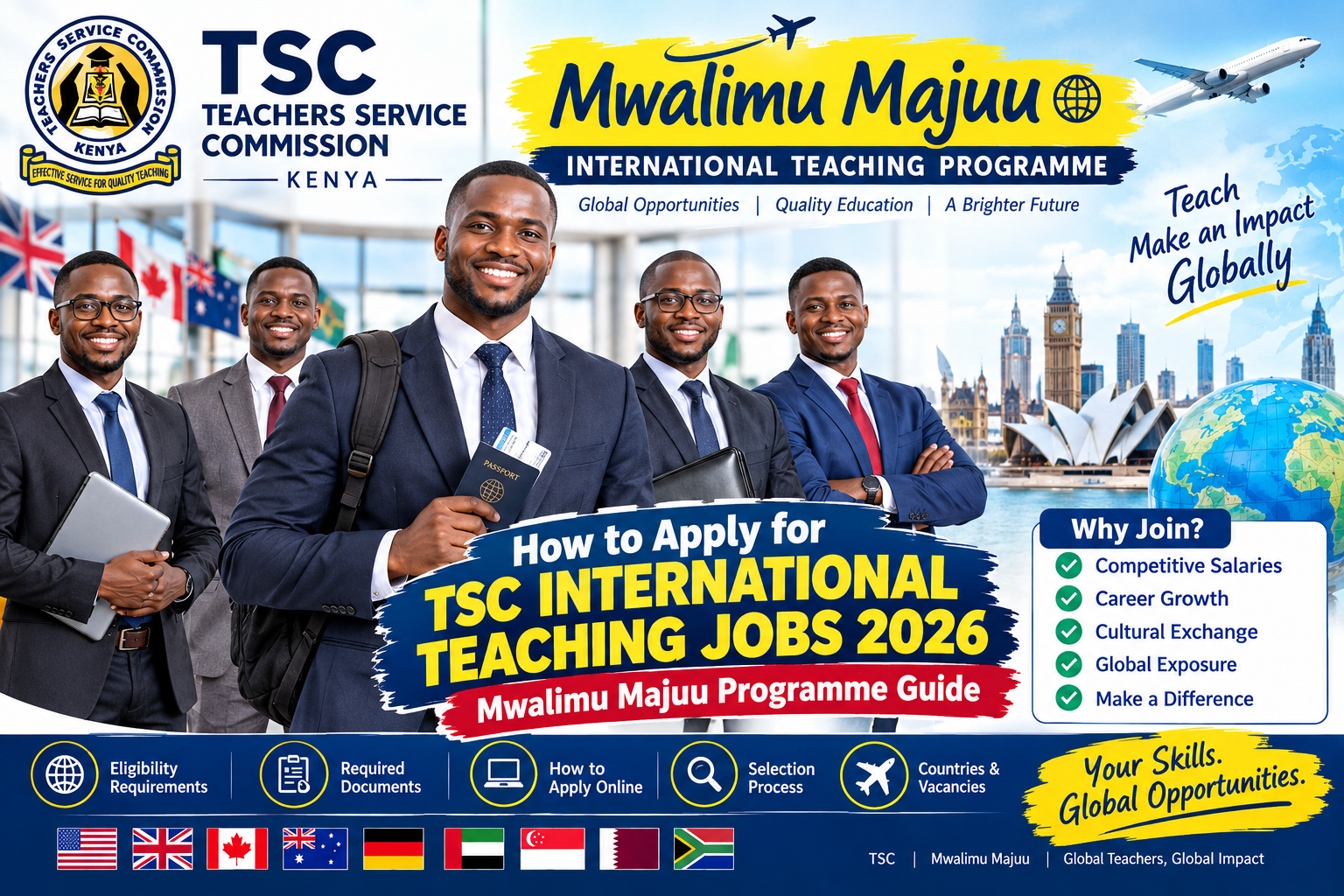
Kenyan teachers looking for employment opportunities outside the country have a new government-backed pathway to explore through the Mwalimu Majuu programme.
The initiative brings together the Teachers Service Commission (TSC) and the State Department for Diaspora Affairs to develop a framework for the ethical, safe and orderly placement of qualified Kenyan teachers in international labour markets.
On 17 June 2026, Principal Secretary for Diaspora Affairs Roseline Njogu held consultations with TSC Chairperson Dr Jamleck Muturi John and Acting TSC CEO Evaleen Mitei on the implementation of the programme. The government said the discussions were focused on strengthening cooperation and operationalising the framework for placing Kenyan teachers in overseas jobs.
This development is important for trained Kenyan teachers who want to build international careers, but applicants should understand that Mwalimu Majuu is a placement framework rather than a guarantee of employment in a particular country or school.
This guide explains what the programme is, who may qualify, the documents to prepare and, most importantly, how to apply for TSC international teaching opportunities when an official vacancy is advertised.
What Is the TSC Mwalimu Majuu Programme?
Mwalimu Majuu refers to the government’s framework for facilitating opportunities for Kenyan teachers to work outside Kenya.
The programme is being advanced through cooperation between TSC and the State Department for Diaspora Affairs. The June 2026 consultations focused on implementing the Policy Framework for Teacher Engagement Outside Kenya, which was developed to guide recruitment and deployment of teachers to foreign countries.
The framework is intended to make international teacher recruitment more structured and safer for Kenyan educators.
Rather than teachers having to depend entirely on private recruitment agents, the government framework is intended to provide a more coordinated pathway involving relevant Kenyan institutions.
Why the programme matters
International teaching opportunities can expose Kenyan teachers to:
- New education systems
- International curricula
- Professional development opportunities
- Multicultural teaching environments
- International work experience
- Potential employment opportunities in countries experiencing teacher shortages
However, individual employment conditions—including salary, accommodation, visas, insurance and working hours—will depend on the specific employer and destination country.
Who Can Apply for TSC International Teaching Jobs?
Eligibility will ultimately depend on the requirements contained in each official international vacancy.
A prospective applicant should generally be prepared to demonstrate:
1. Recognised teacher training
Applicants should have the relevant academic and professional qualifications for the advertised teaching position.
Depending on the vacancy, this could include a:
- Diploma in Education
- Bachelor of Education
- Relevant degree plus recognised teacher training
- Technical or vocational teaching qualification
- Special needs education qualification
The exact qualification required should always be checked against the specific vacancy.
2. TSC registration
For opportunities administered through the TSC framework, professional registration and good standing with the Commission are important considerations.
Teachers should therefore ensure that their TSC registration details are accurate and that they can provide the required professional documentation.
3. Relevant teaching experience
Some international employers may require previous classroom experience.
Experience requirements can vary significantly. A vacancy could specify a minimum number of years, particular age groups or experience with a particular curriculum.
4. Subject specialisation
International vacancies are usually tied to specific staffing needs.
Teachers should therefore pay close attention to the subjects listed in an advertisement rather than assuming that every trained teacher will qualify for every overseas opportunity.
5. Language requirements
Language requirements can differ according to the destination.
For example, a school operating in a non-English-speaking country may require evidence of proficiency in the country’s language, while an international school may operate primarily in English.
Countries Where Kenyan Teachers May Find Opportunities
The Mwalimu Majuu framework is intended to connect Kenyan teachers with international labour markets.
Previous information associated with the programme has identified potential demand for different categories of teachers in several international destinations. Reported areas of demand have included English, Kiswahili and special-needs education.
Potential destinations may include countries in:
- Europe
- The Middle East
- Asia
- Africa
- The Caribbean
- Other international education markets
Importantly, a country mentioned in discussions about Mwalimu Majuu should not automatically be interpreted as having an open 2026 vacancy.
Applicants should wait for an official vacancy or recruitment announcement specifying the country, employer, subject, qualifications, deadline and application procedure.
Subjects That May Have International Opportunities
Demand depends on the requirements of individual countries and schools.
Kenyan teachers may encounter opportunities involving areas such as:
STEM subjects
These can include:
- Mathematics
- Physics
- Chemistry
- Biology
- Computer Studies
- ICT
Languages
Potential opportunities may include:
- English
- Kiswahili
- Other language-related teaching positions
Technical and vocational education
International schools and technical institutions may recruit teachers in areas such as:
- Electrical installation
- Automotive technology
- Agriculture
- Plumbing
- Carpentry and construction
- Technical drawing
- Welding
- Refrigeration and air conditioning
Special Needs Education
Special needs teachers may also find opportunities where overseas employers specifically require specialised educators.
A previous Mwalimu Majuu recruitment opportunity, for example, included technical subjects and special education among the advertised areas.
How to Apply for TSC International Teaching Jobs 2026
The most important thing for applicants is to distinguish between preparing for international recruitment and actually submitting an application for an advertised vacancy.
Here is the recommended step-by-step process.
Step 1: Confirm That an Official Vacancy Has Been Advertised
Do not begin by sending money to an individual claiming to recruit teachers for Mwalimu Majuu.
First look for an official announcement from the relevant government institution or the named recruiting organisation.
Check:
- TSC announcements
- TSC online services
- State Department for Diaspora Affairs announcements
- Official government communication
- The recruitment platform specifically named in the vacancy advertisement
The June 2026 government announcement confirmed that TSC and Diaspora Affairs were working on implementation of the Mwalimu Majuu framework, but applicants should not assume that every online advertisement claiming to be a “TSC international job” is genuine.
Step 2: Read the Vacancy Requirements Carefully
Once an official vacancy is released, read the entire advertisement.
Look for:
- Country of employment
- Employer
- Teaching subject
- Academic qualification
- Professional qualification
- Teaching experience
- Age requirements, if applicable
- Language requirements
- Passport requirements
- Medical requirements
- Police clearance requirements
- Application deadline
- Application method
- Interview requirements
Do not apply simply because you are a registered teacher.
International recruitment is normally vacancy-specific, meaning your qualification must match the position advertised.
Step 3: Prepare Your TSC Registration Information
Make sure your professional information is up to date.
Prepare copies or details of relevant documents, including your:
- TSC registration information
- TSC registration certificate, where required
- National ID
- Academic certificates
- Professional teaching certificates
- Academic transcripts
- Employment or experience records
Use names and dates consistently across your documents.
A mismatch between your passport, academic certificates and professional records can create unnecessary delays during verification.
Step 4: Prepare Your Academic Certificates and Transcripts
International employers may require more than a basic CV.
Prepare clear copies of:
- KCSE certificate
- Teacher-training certificate
- Diploma or degree certificate
- Degree transcripts
- Postgraduate certificates, where applicable
- Other relevant professional certifications
If a destination country requires qualification recognition or equivalency, follow the instructions provided by the relevant authorities.
Do not assume that a Kenyan teaching qualification is automatically recognised in every country.
Step 5: Update Your CV
Your CV should be specifically prepared for an international teaching application.
Include:
Personal information
- Full name
- Contact information
- Nationality
- Professional registration details
Professional profile
Briefly explain your teaching background and areas of expertise.
Education
List your academic qualifications from the most recent.
Teaching experience
Include:
- School or institution
- Position
- Subjects taught
- Classes or age groups taught
- Dates of employment
- Major responsibilities
Professional development
Include relevant:
- CBC training
- ICT training
- Special needs education training
- Leadership courses
- International curriculum training
- Other professional development
Avoid submitting a CV containing unnecessary personal information or unsupported claims.
Step 6: Obtain a Valid Passport
International employment requires appropriate travel documentation.
Teachers intending to pursue overseas employment should ensure that their passport is valid and meets the requirements of the destination country.
Check the specific vacancy for the required passport validity period.
If you do not yet have a passport, begin the application process early rather than waiting until you receive an employment offer.
Step 7: Prepare Police and Other Clearance Documents
Depending on the destination and employer, applicants may be required to provide criminal-record or police-clearance documentation.
Other documents may include:
- Certificate of Good Conduct
- Medical certificate
- Professional references
- Employment letters
- Proof of qualifications
- Authentication or verification documents
Do not obtain expensive documents unnecessarily before reading the official vacancy instructions because requirements vary by country.
Step 8: Submit the Application Through the Official Channel
After confirming eligibility, submit your application using the platform specified in the official advertisement.
This may involve:
- Creating an account.
- Entering personal details.
- Entering academic qualifications.
- Providing professional information.
- Uploading certificates.
- Uploading your CV.
- Uploading your passport or identification documents where requested.
- Reviewing the information.
- Submitting the application.
- Saving the application confirmation.
Never submit sensitive documents through an unofficial WhatsApp number or personal email address unless the official advertisement explicitly identifies that channel.
Step 9: Monitor Your Application
After submitting your application, regularly check the official communication channel used during recruitment.
You may be contacted for:
- Document verification
- Shortlisting
- Interviews
- Skills assessments
- Language assessments
- Additional documentation
- Medical examinations
- Employer interviews
Keep your telephone number and email address active throughout the recruitment process.
Step 10: Attend the Interview or Assessment
Shortlisted applicants may have to undergo one or more interviews.
Prepare to demonstrate:
- Subject knowledge
- Classroom-management skills
- Lesson-planning ability
- Communication skills
- Digital teaching skills
- Understanding of learner diversity
- Knowledge of the curriculum
- Ability to work in a multicultural environment
For international schools, applicants may also be asked about experience with curricula such as Cambridge or International Baccalaureate, depending on the employer.
Step 11: Wait for Verification and Employer Selection
Passing an initial TSC or government screening stage does not necessarily mean that you have secured a job.
There may be additional stages involving:
- Foreign employers
- Education authorities
- Qualification-recognition bodies
- Immigration authorities
- Visa authorities
A teacher should therefore treat an application, shortlist and job offer as separate stages.
Step 12: Review the Employment Contract Before Travelling
If selected, carefully examine the employment contract.
Pay particular attention to:
- Basic salary
- Currency
- Working hours
- Contract duration
- Accommodation
- Transport
- Medical insurance
- Annual leave
- Air tickets
- Visa sponsorship
- Probation
- Contract termination
- Tax obligations
- Pension arrangements
- Renewal conditions
Never travel internationally for employment based only on a verbal promise.
Documents to Prepare for TSC International Teaching Applications
A useful preparation checklist includes:
| Document | Why It May Be Required |
|---|---|
| National ID | Identification |
| Valid passport | International travel and visa processing |
| TSC registration details | Professional verification |
| Teaching certificate | Proof of teacher training |
| Diploma/degree certificate | Academic qualification |
| Academic transcripts | Detailed academic verification |
| Updated CV | Professional profile |
| Employment letters | Experience verification |
| Certificate of Good Conduct | Background checks |
| Professional references | Employer verification |
| Medical documents | Immigration/employer requirements |
| Language certificate | Where required by destination |
The actual list will depend on the specific recruitment advertisement.
Are TSC International Jobs Open to Unemployed Teachers?
The Mwalimu Majuu framework is intended to facilitate international opportunities for qualified Kenyan teachers, including teachers seeking employment abroad.
However, being unemployed does not automatically guarantee selection.
International employers can set their own requirements concerning qualifications, subjects, experience, language ability and curriculum experience.
Teachers should therefore focus on meeting the requirements of each specific vacancy.
Do TSC Intern Teachers Qualify?
Internship status alone should not be treated as automatic eligibility or automatic exclusion.
The answer will depend on the requirements contained in the particular international vacancy.
An applicant who is currently an intern should carefully check whether the advertisement requires:
- Permanent TSC employment
- TSC registration only
- Previous teaching experience
- A specific number of years of experience
- A particular academic qualification
Always follow the published eligibility criteria rather than relying on social-media claims.
How Much Will Teachers Earn Abroad?
There is no single Mwalimu Majuu salary applicable to every Kenyan teacher.
International teachers are employed under different contracts, and remuneration can vary according to:
- Country
- School
- Subject
- Qualification
- Experience
- Curriculum
- Position
- Working hours
- Benefits
- Cost of living
Some contracts may include accommodation, insurance or travel benefits, while others may not.
Therefore, applicants should assess the complete employment package, rather than comparing salaries alone.
How to Avoid Fake TSC International Job Advertisements
The growing interest in overseas teaching opportunities can attract scammers.
Be particularly careful when someone:
- Guarantees a job without an interview.
- Requests money to “secure” a position.
- Uses a personal WhatsApp account as the only application channel.
- Claims to be a TSC official without verifiable identification.
- Offers an unusually high salary without a formal contract.
- Requests your banking PIN or password.
- Sends an unofficial payment link.
- Pressures you to pay immediately.
- Refuses to provide the employer’s name.
- Cannot identify an official government announcement supporting the recruitment.
Remember
A logo does not prove that a recruitment advertisement is genuine.
Scammers can copy TSC and government logos, letterheads and screenshots.
Always verify the source independently.
What Applicants Should Do Before Paying Any Money
Before making any payment connected to overseas recruitment, verify:
- Who is recruiting?
- Who is the actual employer?
- Is there an official vacancy announcement?
- What government institution is involved?
- Is the recruitment platform officially identified?
- What does the employment contract say?
- What fees are legally required?
- Who receives the payment?
- Is an official receipt provided?
Applicants should be especially cautious about individuals claiming that payment will guarantee selection.
TSC International Teaching Jobs and Curriculum Experience
Teachers interested in international employment can strengthen their professional profiles by developing skills relevant to international schools.
Useful areas may include:
- Digital learning
- Competency-based teaching
- Inclusive education
- Special needs education
- Classroom technology
- International assessment
- Cambridge curriculum
- International Baccalaureate
- English-language teaching
- STEM education
However, teachers should distinguish between skills that may improve their professional profile and qualifications that are explicitly required by a vacancy.
Why International Teaching Requires More Than a TSC Certificate
TSC registration establishes professional standing in Kenya, but international employment can involve additional regulatory requirements.
A teacher moving abroad may have to satisfy:
- Foreign teacher-registration rules
- Immigration requirements
- Visa conditions
- Qualification-recognition requirements
- Language requirements
- Employer-specific standards
- Criminal-background checks
- Medical requirements
Consequently, teachers should research the destination country’s requirements before accepting an offer.
Frequently Asked Questions About TSC International Teaching Jobs 2026
1. What is Mwalimu Majuu?
Mwalimu Majuu is the name associated with Kenya’s government effort to facilitate international employment opportunities for Kenyan teachers through cooperation involving TSC and the State Department for Diaspora Affairs. The June 2026 consultations focused on operationalising the framework for teacher engagement outside Kenya.
2. Has the government confirmed the Mwalimu Majuu programme?
Yes. The State Department for Diaspora Affairs published an official June 17, 2026 update confirming consultations between its Principal Secretary and senior TSC officials concerning Mwalimu Majuu.
3. Does Mwalimu Majuu guarantee a teaching job abroad?
No. Participation in the programme or submission of an application should not be interpreted as a guarantee of employment. Selection depends on the requirements and recruitment process for the particular opportunity.
4. Which countries will recruit Kenyan teachers?
The programme is intended to facilitate access to international labour markets, but countries and vacancies can change. Teachers should rely on the specific official recruitment announcement rather than assuming that every country previously mentioned has an active vacancy.
5. Can unemployed teachers apply?
Where an international vacancy is open to unemployed or currently non-employed qualified teachers, they may apply if they satisfy the stated requirements. Employment status alone should not be assumed to determine eligibility.
6. Do teachers need a passport?
International travel generally requires a valid passport. Teachers interested in overseas employment should ensure that their travel documents are ready before recruitment deadlines.
7. Will teachers need a Certificate of Good Conduct?
Some international employers and immigration authorities require police or criminal-record clearance. Applicants should obtain such documents when the official recruitment instructions require them.
8. Can teachers apply through recruitment agents?
Only use an agent or recruitment organisation where its involvement is clearly authorised or identified in the official recruitment process. Do not assume that someone claiming to represent TSC is legitimate.
9. Where should teachers check for updates?
Teachers should monitor official communications from TSC and the State Department for Diaspora Affairs, particularly when a new vacancy or application procedure is announced.
Final Checklist for Kenyan Teachers
Before applying for an international teaching position, make sure you have:
- Valid TSC registration
- Updated CV
- Academic certificates
- Academic transcripts
- Teaching certificates
- Employment/reference letters
- Valid passport
- National ID
- Certificate of Good Conduct if required
- Relevant professional certificates
- Language certification where required
- Scanned copies of important documents
- Active email address
- Active telephone number
- Access to the official recruitment portal
- A copy of the vacancy announcement
Final Thoughts
The Mwalimu Majuu programme represents an important development in Kenya’s efforts to facilitate international labour opportunities for teachers. The June 17, 2026 consultations between TSC and the State Department for Diaspora Affairs confirmed that the two institutions were working on implementation of the framework for placing Kenyan teachers in overseas employment.
For teachers, preparation is essential. Keep your professional records updated, prepare a strong international CV, obtain the necessary travel documents and monitor official recruitment announcements.
Most importantly, do not pay money to anyone simply because they claim to have access to TSC international jobs. Verify every opportunity through the official recruitment channels and read the employment terms carefully before accepting an overseas position.