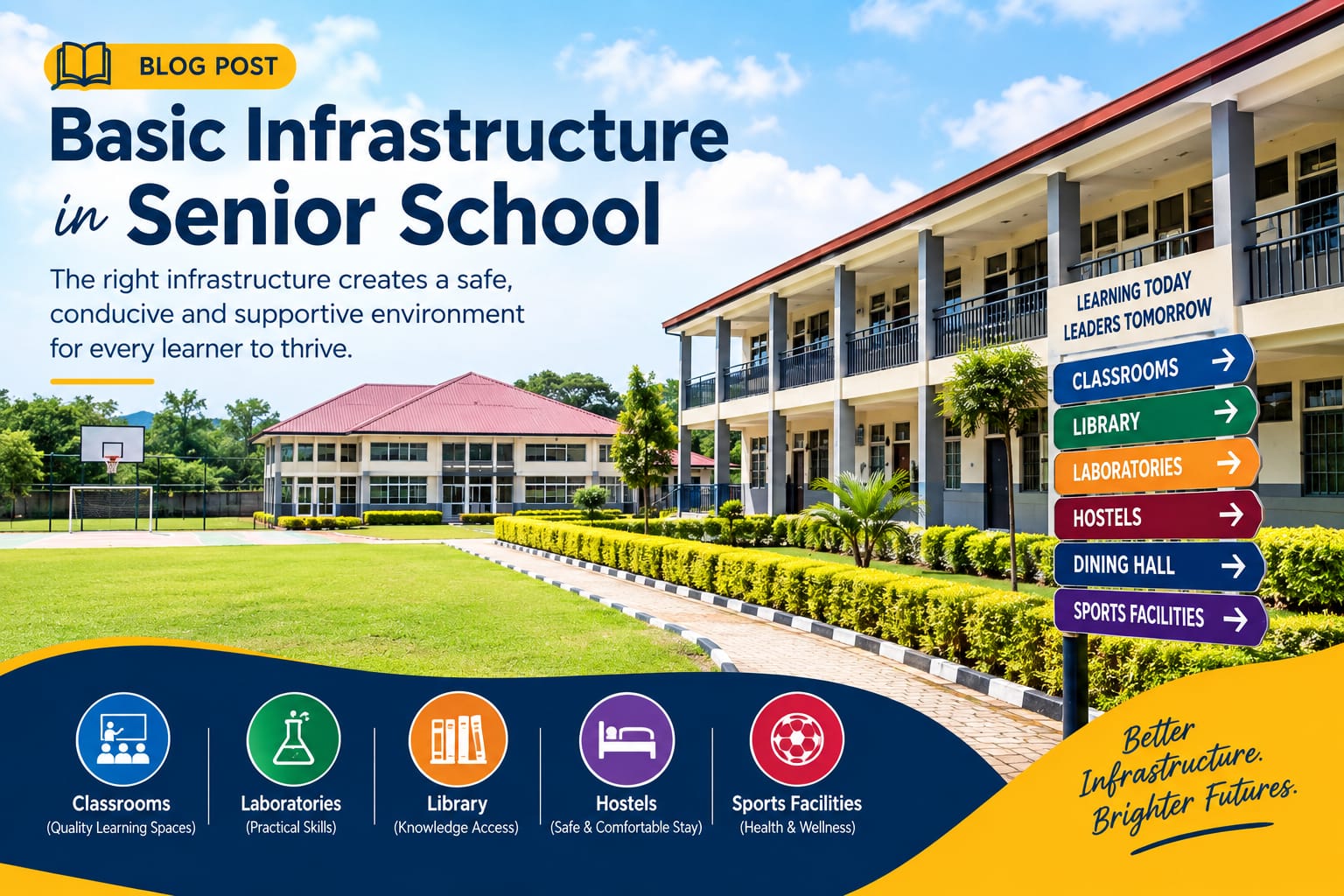
Senior School Infrastructure Requirements in Kenya: Essential Facilities Every School Needs
The transition to Senior School under Kenya’s Competency-Based Education system is changing the infrastructure needs of secondary schools.
Senior School is expected to provide learners with opportunities to pursue different areas of interest while developing practical skills, creativity, critical thinking, communication and other competencies. This means that a school cannot depend entirely on ordinary classrooms.
Modern Senior Schools require a combination of classrooms, laboratories, workshops, ICT facilities, libraries, sanitation facilities, sports grounds, boarding facilities where applicable and spaces for specialised learning.
Infrastructure is therefore an important foundation for successful curriculum implementation.
What Is Senior School Infrastructure?
Senior School infrastructure refers to the physical facilities, equipment and learning spaces required to support teaching, learning, practical activities, assessment and learner welfare.
These facilities may include:
- Classrooms
- Science laboratories
- Computer and ICT rooms
- Workshops
- Libraries
- Art and design spaces
- Music and performing arts facilities
- Agriculture facilities
- Sports fields
- Dining facilities
- Sanitation facilities
- Administration offices
- Guidance and counselling spaces
- Staff facilities
- Boarding facilities where applicable
- Water and electricity
- Internet connectivity
- Accessibility facilities
The exact infrastructure required depends on the subjects and pathways offered by an individual school.
1. Adequate Classrooms
Classrooms remain the basic learning spaces in Senior School.
They should provide sufficient room for:
- Teacher instruction
- Group discussions
- Collaborative activities
- Presentations
- Individual learning
- Assessment
Classrooms should have adequate lighting and ventilation and should be arranged to support different teaching methods.
The competency-based approach makes flexible classroom arrangements increasingly useful because learners may need to work individually, in pairs or in groups.
2. Science Laboratories
Science subjects require appropriate practical facilities.
A well-equipped science laboratory can support activities involving:
- Biology
- Chemistry
- Physics
- Integrated science
- Scientific investigations
Laboratories require appropriate equipment, work surfaces, water supply, storage facilities and safety measures.
Practical learning should not be reduced to theoretical descriptions when learners are expected to develop scientific skills through experimentation and investigation.
3. ICT and Computer Laboratories
Digital technology is increasingly important in education.
Senior Schools need appropriate ICT infrastructure to support:
- Digital literacy
- Online research
- Computer-based learning
- Digital content
- Programming
- Online assessment
- Virtual learning
- Digital projects
- Communication
The facility should ideally have reliable electricity, suitable devices, connectivity and appropriate security.
Where resources permit, schools can also develop wireless connectivity across key learning areas.
4. Libraries and Learning Resource Centres
A Senior School needs spaces where learners can conduct independent research.
A modern library can provide:
- Textbooks
- Reference materials
- Newspapers
- Digital resources
- Research facilities
- Reading spaces
- Study areas
The traditional library can increasingly function as a learning resource centre, combining physical and digital resources.
5. Workshops for Technical and Practical Learning
Schools offering technical or applied learning areas may require specialised workshops.
Depending on the programmes offered, facilities may support areas such as:
- Engineering
- Building and construction
- Woodwork
- Metalwork
- Electrical work
- Automotive activities
- Design
- Manufacturing
- Other technical skills
Workshops require appropriate tools, equipment, storage and safety arrangements.
The infrastructure should correspond to the actual learning programmes offered rather than simply having an empty room labelled “workshop.”
6. Agriculture Facilities
Agriculture-related learning can benefit from practical school-based facilities.
These may include:
- Demonstration farms
- School gardens
- Crop plots
- Livestock units
- Greenhouses where appropriate
- Agricultural tools
- Water systems
- Composting areas
Such facilities allow learners to connect classroom concepts with real agricultural practices.
7. Home Science Facilities
Where relevant learning areas are offered, schools may need appropriate spaces for practical activities involving:
- Food preparation
- Nutrition
- Clothing and textiles
- Household management
- Consumer education
These facilities should have appropriate equipment and safety arrangements.
8. Creative Arts Facilities
Creative and performing arts require spaces that allow learners to practise and demonstrate their abilities.
Schools may need:
- Art rooms
- Music rooms
- Drama spaces
- Performance areas
- Instrument storage
- Display areas
Creative learning can contribute to communication, confidence, collaboration and creativity.
9. Sports Facilities
Physical education and sports require appropriate spaces.
Depending on the school, facilities can include:
- Football fields
- Athletics tracks
- Basketball courts
- Volleyball courts
- Netball courts
- Indoor activity spaces
- Changing rooms
- Sports equipment storage
Sports facilities should be maintained and made as safe as reasonably possible.
10. Water, Sanitation and Hygiene Facilities
No Senior School can operate effectively without adequate water and sanitation infrastructure.
Schools need:
- Reliable water supply
- Toilets
- Handwashing facilities
- Waste-disposal systems
- Clean sanitation facilities
- Appropriate drainage
These facilities are particularly important because learners and teachers spend many hours at school every day.
11. Electricity and Reliable Power
Electricity supports almost every modern school activity.
It is required for:
- Computers
- Internet equipment
- Projectors
- Laboratory equipment
- Lighting
- Security systems
- Digital learning
- Charging devices
Schools in areas where the electricity supply is unreliable may need appropriate alternative power solutions, subject to available resources and applicable safety requirements.
12. Internet Connectivity
Internet access can support Senior School learning through:
- Online research
- Digital curriculum resources
- Virtual learning environments
- Online collaboration
- Digital libraries
- Teacher professional development
- Educational videos
- Online communication
However, connectivity should be accompanied by responsible digital-use policies and learner safety measures.
13. Accessible Infrastructure
Senior School infrastructure should take the needs of learners with disabilities into account.
Schools should consider:
- Ramps
- Accessible toilets
- Suitable pathways
- Appropriate classroom access
- Handrails
- Accessible learning spaces
- Other assistive facilities
Infrastructure planning should aim to ensure that learners are not excluded from educational opportunities because of physical barriers.
14. Dining and Food Facilities
Boarding schools and schools providing meals require suitable food-service facilities.
These may include:
- Kitchens
- Dining halls
- Food storage
- Clean water
- Food preparation areas
- Waste-management systems
Food facilities should meet relevant health and safety requirements.
15. Boarding Facilities
For boarding Senior Schools, infrastructure may include:
- Dormitories
- Beds and lockers
- Bathrooms
- Toilets
- Dining facilities
- Study areas
- Security arrangements
- House-parent or supervision facilities
Boarding infrastructure should support both safety and learner wellbeing.
16. Guidance and Counselling Spaces
Senior School learners require support as they make decisions about education, careers and personal development.
A designated counselling space can provide privacy for:
- Career guidance
- Individual counselling
- Mentorship
- Learner support
- Educational consultations
The space should provide an appropriate level of confidentiality and accessibility.
17. Staff Facilities
Quality infrastructure should also consider teachers and other school employees.
Schools need appropriate:
- Staffrooms
- Offices
- Departmental workspaces
- Meeting spaces
- Storage
- Sanitation facilities
Teachers need suitable working environments for lesson preparation, assessment and collaboration.
18. Security Infrastructure
Schools should also consider infrastructure that contributes to the safety of learners and staff.
This may include:
- Secure gates
- Perimeter fencing where appropriate
- Lighting
- Controlled access
- Emergency exits
- Fire-safety equipment
- First-aid facilities
- Safe storage of laboratory and workshop materials
Safety requirements should be integrated into infrastructure planning rather than added as an afterthought.
19. Waste Management
Modern schools generate different forms of waste.
Senior Schools should have systems for:
- General waste
- Laboratory waste
- Food waste
- Recyclable materials
- Sanitary waste
- Appropriate disposal
Learners can also participate in environmental projects that turn waste management into a practical learning opportunity.
20. Infrastructure for Competency-Based Learning
The most important question is not simply:
“Does the school have enough buildings?”
The better question is:
“Can the available infrastructure support the competencies learners are expected to develop?”
For example:
| Competency/Activity | Useful Infrastructure |
|---|---|
| Scientific investigation | Science laboratories |
| Digital literacy | ICT facilities |
| Technical skills | Workshops |
| Agriculture | Demonstration farms |
| Creativity | Art and performance spaces |
| Collaboration | Flexible classrooms |
| Research | Library/resource centre |
| Physical development | Sports facilities |
| Digital learning | Internet and devices |
| Career development | Guidance facilities |
| Practical projects | Specialised learning spaces |
This approach helps schools connect infrastructure investment to actual learning outcomes.
Challenges Facing Senior School Infrastructure
Infrastructure development can be affected by several challenges.
Limited funding
Construction, equipment and maintenance require substantial financial resources.
Unequal access
Schools in different geographical and socioeconomic settings may have very different infrastructure levels.
Rapid technological change
ICT equipment can become outdated quickly.
Maintenance
Building facilities is only the beginning. Equipment and buildings require regular maintenance.
Teacher capacity
Specialised infrastructure is most useful when teachers have the skills to use it effectively.
Overcrowding
A school may have facilities on paper but still struggle if too many learners share limited resources.
How Schools Can Prioritise Infrastructure Development
Schools do not necessarily need to develop every facility simultaneously.
A practical approach is to:
1. Identify the curriculum requirements.
Determine which learning areas and pathways the school offers.
2. Conduct an infrastructure audit.
Identify existing facilities and gaps.
3. Prioritise essential facilities.
Focus first on infrastructure directly required for curriculum delivery, safety and learner welfare.
4. Equip existing facilities.
A laboratory without appropriate equipment may have limited educational value.
5. Plan for maintenance.
Include maintenance costs in infrastructure planning.
6. Consider partnerships.
Where appropriate, schools can work with government agencies, communities, development partners and other stakeholders within applicable regulations.
7. Expand gradually.
Infrastructure development can be phased according to available resources and actual learner needs.
Final Takeaway
Senior School infrastructure is no longer simply about having enough classrooms.
The needs of competency-based education require learning environments where learners can experiment, research, create, collaborate, practise practical skills, use technology and demonstrate what they have learned.
The infrastructure of a Senior School should therefore reflect its curriculum and learner pathways.
A well-planned school combines classrooms, laboratories, workshops, ICT facilities, libraries, creative spaces, sports facilities, sanitation, water, electricity, accessibility features and learner-support spaces to create an environment where competencies can be developed in both theory and practice.
The ultimate goal is not to build the largest school possible. It is to develop safe, accessible and functional learning spaces that directly support quality teaching, practical learning and the successful development of Senior School learners.