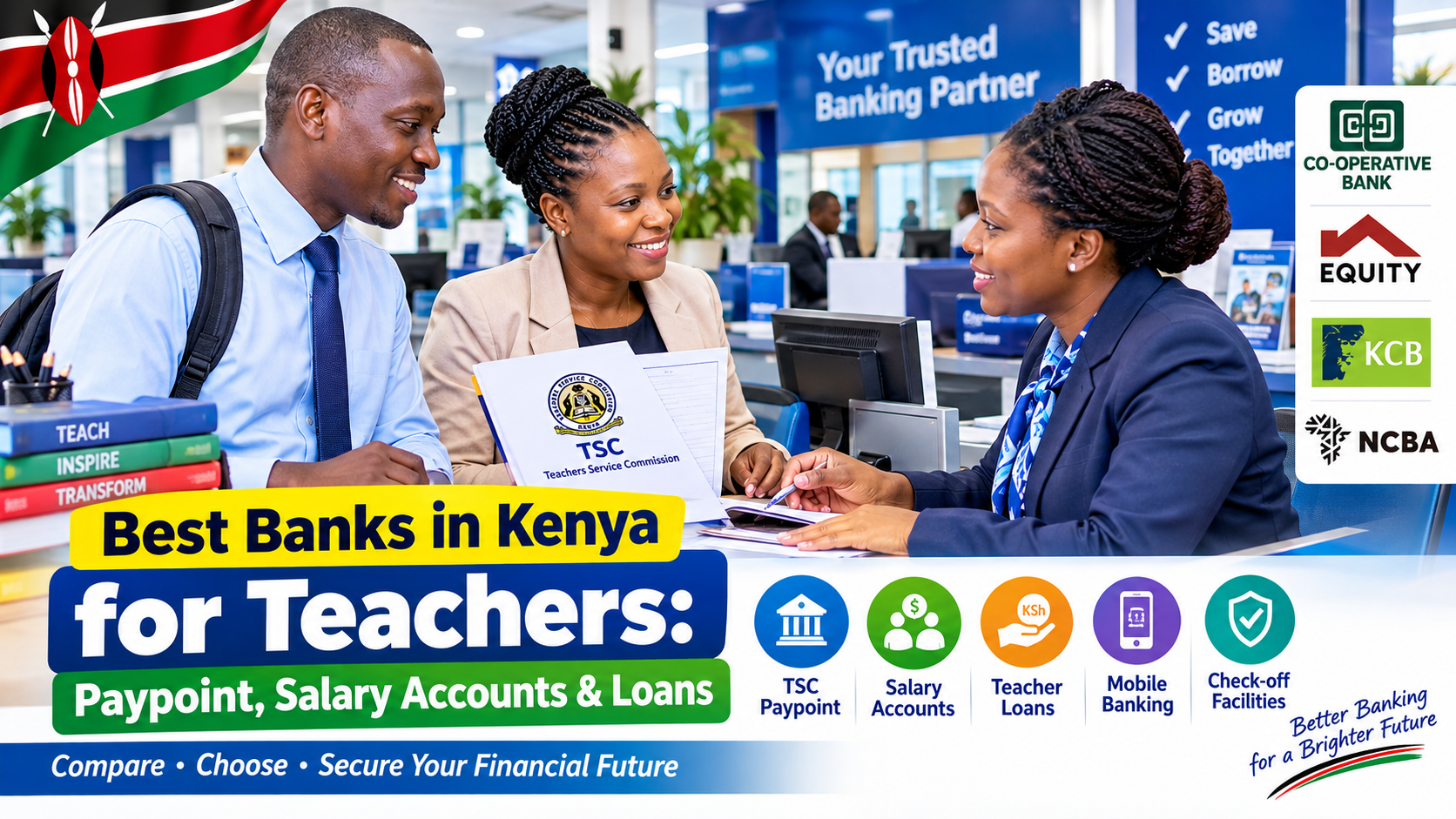
Best Banks in Kenya for Teachers: Paypoint, Salary Accounts and Loans
Introduction
Choosing the Best Bank as a Teacher in Kenya
For a teacher employed by the Teachers Service Commission (TSC), choosing a bank is about much more than finding a place to receive your monthly salary.
The right bank can make it easier to manage your TSC salary, access personal loans, receive salary advances, make payments, save money and handle everyday financial needs.
For teachers who want to borrow, the choice of bank can be even more important. Different banks have different lending policies, repayment periods, fees, eligibility requirements and methods of calculating interest.
Some teachers are primarily interested in a convenient salary paypoint, while others are looking for a large development loan, school-fees loan, emergency loan, mortgage or asset-financing facility.
This guide examines some of the major banks that teachers in Kenya can consider and explains what to look at before moving your TSC salary to a new bank.
Important: There is no single bank that is automatically the best for every teacher. Loan offers depend on factors such as salary, existing deductions, employment status, credit history, relationship with the bank and the lender’s current terms.
What Is a Bank Paypoint for TSC Teachers?
A salary paypoint is the bank account designated to receive your monthly salary from TSC.
Teachers may change their salary paypoint for several reasons, including:
- Accessing a loan
- Moving to a bank with better services
- Access to a wider ATM/agent network
- Lower banking costs
- Better mobile banking
- Access to salary advances
- Consolidating existing loans
- Personal financial preferences
TSC has specifically cautioned teachers who change salary accounts not to close their old account immediately. According to TSC guidance published in its Mwalimu News material, a teacher should keep the old account open until salary has successfully been credited to the new account because a paypoint change may not take effect in the current payroll cycle.
This is an important practical point when changing banks.
Best Banks in Kenya for Teachers
Several commercial banks have products that may suit salaried teachers.
Among the major institutions worth comparing are:
- Equity Bank
- KCB Bank
- Co-operative Bank
- Absa Bank Kenya
- Stanbic Bank Kenya
- Standard Chartered Bank Kenya
- NCBA Bank
- Other banks offering competitive salary and personal-loan products
Rather than simply declaring one bank the “best,” teachers should compare the banks according to their specific objective.
1. Equity Bank – Salary Banking and Accessibility
Equity Group Holdings
Equity Bank is one of the most widely recognized banking institutions in Kenya and has a large customer network.
For teachers, one of its important advantages is accessibility. Teachers working in towns and rural areas may find Equity branches, agents and other banking channels convenient.
Equity has also historically had a significant relationship with teachers. In a 2022 publication, Equity said it was processing approximately KSh 1.8 billion in teachers’ salaries each month and reported approximately 43,000 teachers with loans at that time.
Why teachers may consider Equity
- Large branch network
- Extensive agent network
- Mobile banking services
- Salary-account facilities
- Personal lending
- Access to various financial products
- Convenient banking in many parts of Kenya
Equity loans for teachers
A teacher considering Equity should ask specifically about:
- Salary loans
- Personal loans
- Emergency credit
- School-fees financing
- Asset financing
- Loan consolidation
The actual amount a teacher qualifies for will depend on the individual’s financial profile rather than simply being a teacher.
Who may find Equity convenient?
Teachers who value accessibility, a large banking network and multiple digital and physical banking channels may want to include Equity in their comparison.
2. KCB Bank – Large Loans and Long-Term Financing
KCB Group
Kenya Commercial Bank (KCB) is another major institution that teachers can consider for salary banking and borrowing.
KCB’s broad banking operations include personal finance and longer-term financing products.
Why consider KCB?
Teachers may consider KCB when looking for:
- Salary banking
- Personal loans
- Asset financing
- Housing finance
- Longer-term borrowing
- Banking and investment services
A teacher planning a major financial project such as building a house, purchasing land or financing an asset may want to compare KCB’s offer with those of other banks and SACCOs.
What to compare
Before accepting a KCB loan, ask for:
- Total amount payable
- Monthly instalment
- Interest calculation method
- Processing charges
- Insurance costs
- Early repayment conditions
- Loan restructuring terms
A large maximum loan amount does not necessarily mean the loan is the most affordable.
3. Co-operative Bank – A Strong Option to Compare
Co-operative Bank of Kenya
Co-operative Bank is another major bank frequently considered by salaried workers and members of cooperative societies.
This makes it particularly relevant to teachers who are also active in SACCOs or cooperative financial arrangements.
Potential advantages
Teachers can compare Co-operative Bank for:
- Salary accounts
- Personal loans
- School-fees financing
- Asset financing
- Check-off arrangements
- Savings products
- Business banking
Bank versus SACCO
Teachers should not automatically assume that a bank loan will be cheaper than a SACCO loan.
A teacher who belongs to a SACCO should obtain quotations from both institutions and compare the total cost of borrowing.
For example:
Bank offer
Loan: KSh 2,000,000
Monthly repayment: KSh X
Fees: KSh Y
Insurance: KSh Z
SACCO offer
Loan: KSh 2,000,000
Monthly repayment: KSh A
Fees: KSh B
Insurance: KSh C
The important number is not simply the advertised interest rate. It is the total amount you will eventually repay.
4. Absa Bank Kenya – Compare Its Salary Loan Offers
Absa Bank Kenya
Absa Bank Kenya provides personal banking and lending products that may be relevant to salaried teachers.
It is worth including Absa when comparing salary-based borrowing because lending costs can differ significantly between banks.
Market data published during 2026 shows meaningful differences in average lending rates between Kenyan banks. For example, February 2026 data reported by PesaMarket, based on CBK commercial-bank lending data, showed Standard Chartered and Stanbic among banks with lower average lending rates, while Equity, KCB and Co-operative were higher in that particular dataset.
However, a bank’s sector-wide average lending rate is not the same as the individual rate a particular teacher will receive.
Your personal quotation is what matters.
5. Stanbic Bank Kenya – Compare for Loan Pricing
Stanbic Bank Kenya
Stanbic is another bank teachers can include when comparing personal loans and salary banking.
Recent 2026 market data has placed Stanbic among banks with relatively low average lending rates.
However, teachers should not interpret this as a guarantee that an individual Stanbic loan will be cheaper.
Your quotation can depend on:
- Salary
- Employer
- Loan amount
- Loan term
- Credit history
- Existing obligations
- Security
- Product type
Therefore, ask the bank for the effective cost of the specific loan you qualify for.
6. Standard Chartered Bank Kenya
Standard Chartered Kenya
Standard Chartered is another institution worth comparing, particularly when the primary consideration is the cost of personal borrowing.
Recent 2026 market data has shown Standard Chartered among banks with relatively low average lending rates.
But again, an average banking-sector figure should not be treated as your personal loan quotation.
A teacher should request a written illustration showing:
Loan amount + interest + fees + insurance + monthly repayment + total repayment.
That makes comparisons much more meaningful.
7. NCBA Bank – Digital and Personal Banking
NCBA Group
NCBA is another bank teachers can consider for salary banking and personal finance.
It has a strong digital-banking presence and provides various retail banking products.
Teachers looking for short-term or emergency financing can compare NCBA’s available products against those offered by their existing bank.
However, short-term credit can become expensive if repeatedly rolled over or used to cover ordinary monthly expenses.
Bank Loan vs SACCO Loan for Teachers
One of the biggest mistakes teachers make is comparing only banks.
A teacher should ideally compare commercial banks and SACCOs before taking a large loan.
Teacher-focused financial institutions can structure loans differently from commercial banks.
For example, SACCO borrowing may be influenced by:
- Member savings
- Share capital
- Loan multiplier
- Membership period
- Guarantors
- Existing loans
- Monthly contributions
Bank lending, on the other hand, may place greater emphasis on:
- Salary
- Credit history
- Existing deductions
- Employment status
- Loan affordability
- Banking relationship
- Security where applicable
Understanding TSC Check-Off Loans
TSC has formal guidelines governing its payroll check-off facility.
TSC’s published third-party guidelines explain that the Commission manages third-party deductions through its payroll systems and T-Pay platform. The guidelines also refer to an employee’s ability to accommodate deductions, including a minimum salary-ability concept based on at least one-third of basic salary, subject to applicable rules or criteria.
This is important because a teacher cannot simply assume that a bank will approve any loan amount based on gross salary.
Your existing deductions matter.
Existing deductions may include:
- SACCO loan
- Bank loan
- Insurance
- Pension-related deductions
- Union or other authorized deductions
- Other payroll deductions
Therefore, two teachers earning the same gross salary can qualify for very different loan amounts.
How Much Can a Teacher Borrow?
There is no universal amount that every TSC teacher can borrow.
A lender may consider:
1. Basic salary
The basic salary is an important component of affordability calculations.
2. Net salary
Your take-home pay is crucial because the lender needs to determine whether you can comfortably service the new loan.
3. Existing loans
If you already have several loans, the amount available for another facility may be significantly reduced.
4. Credit history
Your repayment history can affect the lender’s assessment.
5. Loan period
A longer repayment period can reduce the monthly instalment but increase the total interest paid over the life of the loan.
6. Type of loan
A school-fees loan, personal loan, development loan, mortgage and emergency loan can have completely different terms.
Example: Comparing a KSh 2 Million Teacher Loan
Suppose a teacher wants to borrow:
KSh 2,000,000
Do not ask only:
“How much will you give me?”
Instead ask each lender for a complete repayment schedule.
Request:
- Interest rate
- Monthly instalment
- Number of months
- Processing fee
- Insurance
- Other charges
- Total repayment
- Early settlement amount
Imagine Bank A offers a slightly lower monthly payment than Bank B.
That does not automatically mean Bank A is cheaper.
Bank A might have a longer repayment period, meaning you pay interest for more months.
Why the Interest Rate Alone Is Not Enough
A common mistake when comparing Kenyan bank loans is looking at the advertised interest rate and stopping there.
Consider two hypothetical offers:
Bank A
Interest rate: 13.5%
Processing fee: KSh 40,000
Insurance: KSh 20,000
Term: 60 months
Bank B
Interest rate: 14.0%
Processing fee: KSh 10,000
Insurance: KSh 15,000
Term: 48 months
You cannot determine the better financial outcome from the interest rates alone.
You need the total cost of credit.
Best Bank for Teachers’ Salary Paypoint
The best paypoint depends heavily on where you work and how you use your money.
Consider the following.
ATM availability
If your school is in a rural area, a bank with limited physical access may become inconvenient.
Agent network
A strong agent network can be more useful than having a branch several kilometres away.
Mobile banking
Check:
- App reliability
- Transfer charges
- Bill-payment options
- Mobile-money integration
- Account management features
Bank charges
Look at:
- Monthly account fees
- ATM charges
- Transfers
- Cash withdrawals
- Mobile banking charges
- Card fees
Should You Move Your TSC Salary to Get a Loan?
This is one of the most important questions teachers should ask.
Some banks may provide better loan terms to customers who receive their salary through that institution.
That can make changing your paypoint attractive.
However, do not move your salary simply because someone tells you:
“This bank gives teachers the biggest loan.”
Instead, request a formal loan quotation.
Compare the quotation with your current bank and SACCO.
What Happens When You Change Your Salary Paypoint?
Changing a salary paypoint should be handled carefully.
TSC’s published material warns teachers not to immediately close their previous salary account after requesting a change. The reason is that the change may not be reflected in the payroll immediately.
A safer approach is:
Step 1: Open the new account.
Step 2: Submit the appropriate salary-paypoint change through the required process.
Step 3: Confirm that the change has been received/processed.
Step 4: Keep the old account active.
Step 5: Confirm that your salary reaches the new account.
Step 6: Only then consider closing or changing the old account, after checking whether existing loans or standing instructions are attached to it.
Best Bank for a Teacher Seeking a Large Loan
For a large loan, do not select a bank based solely on reputation.
Instead, compare at least three offers.
For example:
Bank A: KSh 3 million
Bank B: KSh 3.2 million
SACCO: KSh 3 million
The fact that Bank B offers KSh 3.2 million does not necessarily make it the cheapest or most suitable.
The important questions are:
- What is the monthly repayment?
- How long is the repayment period?
- What is the total repayment?
- What are the fees?
- What happens if you repay early?
- Can the loan be restructured?
- What deductions will remain on your payslip?
Best Bank for Teacher Emergency Loans
For an emergency, speed may matter more than getting the absolute lowest possible rate.
Teachers may compare:
- Salary advance
- Mobile loan
- Emergency loan
- SACCO emergency facility
- Personal loan
But emergency borrowing should ideally remain small and short-term.
Borrowing KSh 50,000 to solve a genuine short-term emergency is very different from repeatedly taking emergency loans to pay ordinary household expenses.
Best Bank for Teachers Building a House
If your objective is construction, compare a development/construction loan rather than an ordinary short-term personal loan.
You should also compare SACCO financing.
Ask lenders about:
- Maximum loan amount
- Repayment period
- Security requirements
- Valuation charges
- Legal costs
- Insurance
- Construction-stage disbursement
- Interest rate
- Early repayment
For a large construction project, the difference between loan structures can have a significant effect on the total cost.
Best Bank for Teachers Buying Land
Land financing requires careful planning.
Before borrowing, calculate:
Land price + legal fees + valuation + transfer costs + loan costs + other transaction expenses.
Do not use every available shilling for the purchase price and then discover that you lack money for the transaction costs.
Best Bank for School Fees
Teachers with children in secondary school, college or university may consider:
- School-fees loans
- Salary advances
- SACCO school-fees facilities
- Personal loans
Before borrowing, compare the repayment period with the school-fees cycle.
A loan that requires repayment over several years to finance a short-term expense can increase the overall cost substantially.
How to Choose the Right Bank as a TSC Teacher
Use this simple checklist.
Choose based on your priority:
If you want accessibility:
Compare branch, ATM and agent networks.
If you want a large loan:
Compare maximum eligibility and total repayment.
If you want a cheaper loan:
Compare effective cost, not just advertised interest rates.
If you want emergency money:
Compare processing speed and total short-term borrowing cost.
If you want to build:
Compare development loans, mortgages and SACCO facilities.
If you want school-fees financing:
Compare repayment period and total cost.
If you want convenient salary banking:
Compare digital services, charges and physical accessibility.
Important Questions to Ask Every Bank
Before signing a loan agreement, ask the bank these 15 questions:
- What is the interest rate?
- Is the rate fixed or variable?
- How is interest calculated?
- What is the maximum loan amount?
- What is the maximum repayment period?
- What is my monthly instalment?
- What is the total amount I will repay?
- What processing fee will I pay?
- Is loan insurance required?
- Are there additional charges?
- What happens if I repay early?
- Can the loan be refinanced?
- Can existing loans be consolidated?
- What happens if my salary changes?
- How will the loan affect my monthly take-home pay?
Get the answers in writing.
Bank Lending Rates in Kenya: Why Teachers Should Compare Current Offers
Kenya’s lending market changes over time.
For example, market data published in 2026 showed noticeable differences in average lending rates between commercial banks. July 2026 data reported by Khusoko placed KCB at about 14.79%, Equity at about 14.83% and Co-operative Bank at about 15.10% in the cited dataset.
These figures are useful for understanding the broader market, but they should not be treated as guaranteed teacher-loan rates.
The rate you receive can be different.
This is why teachers should obtain current quotations directly from lenders before making a decision.
How TSC Teachers Can Avoid Loan Problems
Taking a large loan can improve your financial position when used productively, but it can also create long-term pressure.
Avoid borrowing the maximum simply because you qualify.
If a bank says you qualify for KSh 4 million, you do not necessarily need to borrow KSh 4 million.
Borrow according to the actual project.
Avoid taking a new loan to finance consumption
Borrowing to build an income-generating asset can have a different financial purpose from borrowing repeatedly for household consumption.
Keep an emergency fund
Unexpected expenses are one of the main reasons people take expensive emergency loans.
Even a small emergency reserve can reduce the need for short-term borrowing.
Compare SACCOs
Teachers should not limit themselves to commercial banks.
A suitable SACCO can provide an alternative source of financing depending on membership requirements and loan terms.
Frequently Asked Questions
Which is the best bank in Kenya for TSC teachers?
There is no universally best bank for every teacher. Equity, KCB, Co-operative Bank, Absa, Stanbic, Standard Chartered and NCBA are among the institutions teachers can compare. The appropriate choice depends on salary banking needs, loan requirements, charges, accessibility and the specific offer available to the teacher.
Which bank gives teachers the biggest loan?
Loan limits vary by bank and individual borrower. Salary, existing deductions, repayment history, loan period and other affordability factors influence the amount available. A teacher should obtain quotations from several lenders rather than relying on a general maximum-loan advertisement.
Can I change my TSC salary paypoint?
Teachers can request changes to their salary paypoint through the applicable TSC process. TSC material advises teachers to keep their old salary account open until the salary has successfully been credited to the new account.
Is a bank loan better than a SACCO loan?
Neither is automatically better. Compare the specific interest rate, fees, repayment period, total repayment, collateral/guarantor requirements and flexibility of each offer.
Can a teacher have more than one loan?
A teacher may have multiple financial obligations, but the ability to take additional borrowing depends on affordability, existing deductions and the lender’s criteria. TSC’s payroll check-off framework includes rules concerning the employee’s ability to accommodate deductions.
What should I do before changing my salary bank?
Open the new account, follow the applicable paypoint-change process, confirm the change and keep your old account open until your salary has successfully reached the new account.
Final Thoughts: Finding the Right Bank for Your Teaching Career
For Kenyan teachers, choosing a bank should be a financial decision rather than simply a search for the bank offering the largest loan.
A good salary account should make everyday banking convenient. A good loan should have repayment terms that fit your income and financial objectives.
The major banks worth comparing include Equity, KCB, Co-operative Bank, Absa, Stanbic, Standard Chartered and NCBA, while teachers should also consider SACCO financing when looking for larger or longer-term loans.
Most importantly, compare the actual loan quotation.
Look beyond the headline interest rate and calculate:
Loan amount + interest + fees + insurance + repayment period = total cost of borrowing.
That is the figure that can help a teacher make a properly informed financial decision.
TSC continues to publish official information and guidelines through its downloads and policy resources, including its third-party payroll check-off guidelines.