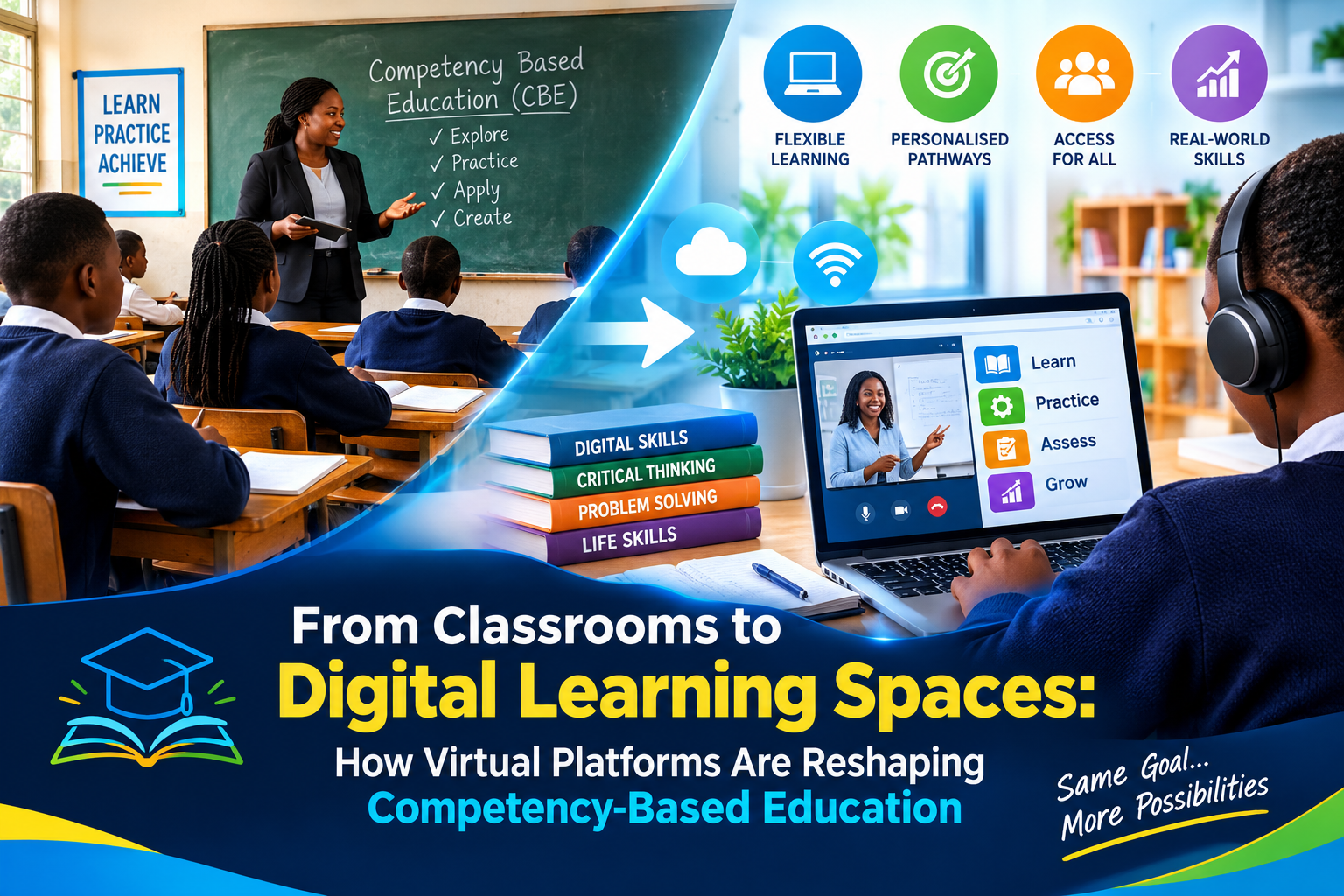
From Classrooms to Digital Learning Spaces: How Virtual Platforms Are Reshaping Competency-Based Education
Education is moving into a new digital era. The traditional classroom, where a teacher stands in front of learners while students listen, take notes and complete written exercises, is gradually being complemented by a much broader learning environment.
Virtual Learning Environments (VLEs) are at the centre of this transformation.
A Virtual Learning Environment is a digital space where teachers and learners can interact, access learning materials, complete assignments, communicate, collaborate and monitor learning progress. It may include a Learning Management System (LMS), online classrooms, digital content platforms, discussion forums, virtual laboratories, electronic portfolios and digital assessment tools.
For Competency-Based Education (CBE), this development is particularly significant.
Competency-based education focuses on what learners can do with the knowledge and skills they acquire. Instead of concentrating entirely on memorisation and examination performance, the approach gives greater attention to application, creativity, communication, collaboration, critical thinking, problem-solving and practical performance.
Virtual learning platforms can provide new ways of developing and demonstrating these competencies.
A New Generation of Learning
The modern learner is growing up in a world where information is available through smartphones, computers, digital libraries, educational videos and interactive applications.
This means schools are no longer the only places where learning takes place.
A learner can research a topic online, watch an instructional video, participate in a virtual discussion, complete an online activity and submit a project without being physically present in a classroom.
This does not mean that physical schools are becoming unnecessary.
Instead, technology is expanding the classroom.
The classroom becomes a combination of:
- Physical learning spaces
- Digital platforms
- Online resources
- Practical environments
- Collaborative projects
- Community-based learning
- Virtual activities
This creates a more connected learning ecosystem.
Why Virtual Learning Matters to Competency-Based Education
Competency-based education requires learners to demonstrate skills rather than simply reproduce information.
This creates a challenge for conventional teaching.
A two-hour examination may show whether a learner can answer questions, but it may not fully demonstrate creativity, teamwork, communication, practical skills or the ability to solve an authentic problem.
Virtual environments can provide additional opportunities for learners to demonstrate these abilities.
For example, a learner can:
- Create a digital presentation.
- Record a practical demonstration.
- Participate in an online discussion.
- Work on a group project.
- Develop a digital portfolio.
- Complete an interactive simulation.
- Conduct online research.
- Submit a video explaining a solution.
The teacher therefore has more evidence with which to understand learner progress.
1. Learning Is Becoming More Learner-Centred
One of the most important changes introduced by digital learning is the movement away from a purely teacher-directed model.
In a conventional lesson, the teacher often controls:
- What is taught
- When it is taught
- How it is taught
- When learners practise
- When learners are assessed
A virtual environment can give learners greater control over aspects of the learning process.
Students can revisit lessons, repeat activities, access additional resources and sometimes progress through materials at different speeds.
This supports the idea that learners should actively participate in constructing their knowledge.
The teacher remains important, but the learner becomes a more active participant.
2. The Digital Portfolio Could Become More Important
Competency-based education needs evidence.
A learner should have opportunities to demonstrate progress over time.
Digital portfolios can provide a convenient way of collecting this evidence.
A learner’s portfolio could contain:
- Research projects
- Written assignments
- Photographs of practical activities
- Videos
- Presentations
- Designs
- Art work
- Reflections
- Group projects
- Teacher feedback
- Assessment records
Instead of looking at one examination result, educators can potentially examine a wider collection of learner work.
This creates a more detailed picture of development.
3. Teachers Can See Learning Progress More Clearly
Digital platforms can record different types of learner activity.
Depending on the platform, teachers may be able to monitor:
- Assignment submissions
- Quiz performance
- Participation
- Learning-resource access
- Completion of activities
- Progress through modules
- Areas where learners repeatedly struggle
This information can help teachers identify learners who require additional support.
For example, if many learners perform poorly on a particular digital activity, the teacher may decide to revisit the concept.
The data therefore becomes an additional source of information for instructional decisions.
4. Feedback Can Become Part of the Learning Process
Competency development requires practice and improvement.
A learner may not demonstrate a competency successfully the first time.
Virtual platforms can make it easier to establish a cycle of:
Attempt → Feedback → Correction → Practice → Improvement
A teacher can provide comments on digital assignments.
Automated quizzes can provide immediate responses.
Peer-review activities can allow students to evaluate each other’s work.
Learners can then use the feedback to improve their next attempt.
This changes assessment from an activity that happens only at the end of learning into something that can happen throughout the learning process.
5. Practical Learning Can Enter the Digital Space
A major misconception is that virtual learning means learners only read digital notes.
Modern virtual learning can go much further.
Digital simulations can create environments where learners practise decision-making and problem-solving.
For example, learners studying business could work through a simulated business environment.
Agriculture learners could analyse crop-production scenarios.
Science learners could interact with virtual experiments before carrying out physical experiments.
ICT learners can develop digital projects.
Language learners can record presentations and practise communication skills.
The physical and virtual environments can therefore complement one another.
6. Collaboration Is No Longer Limited by the Classroom
Competency-based education values collaboration.
Virtual platforms can provide new opportunities for students to work together.
Learners can collaborate through:
- Discussion boards
- Shared documents
- Video meetings
- Group assignments
- Digital presentations
- Peer-review activities
- Online project spaces
This is increasingly relevant because modern workplaces rely heavily on digital communication and teamwork.
Learning how to collaborate digitally can therefore become a useful life and workplace skill.
7. Parents Can Become More Connected to Learning
Virtual environments can also create new possibilities for communication between schools and families.
Depending on the platform, parents may receive information about:
- Assignments
- School activities
- Learning progress
- Important announcements
- Attendance
- Assessment activities
This can help families understand what learners are expected to achieve.
However, schools must ensure that communication remains appropriate and that learner information is handled securely.
8. Virtual Learning Can Support Different Learning Needs
Learners have different strengths and challenges.
Some understand concepts through reading.
Others learn better through demonstrations, diagrams, audio or video.
Digital environments can provide multiple formats.
A single topic may be presented through:
- Text
- Video
- Audio
- Animation
- Infographics
- Interactive exercises
- Simulations
- Practical activities
This can provide learners with more than one pathway to understanding a concept.
It can also support differentiated learning when teachers deliberately design activities for different learner needs.
9. Digital Skills Are Becoming Part of the Competency Equation
Learners are preparing for a world where digital skills are increasingly important.
Consequently, virtual learning does more than deliver curriculum content.
It can also help learners develop digital competencies.
Students may learn how to:
- Search for information
- Evaluate online sources
- Communicate digitally
- Create presentations
- Manage digital files
- Collaborate online
- Produce digital content
- Protect personal information
These abilities can complement other competencies such as creativity, communication and critical thinking.
10. Artificial Intelligence Will Add Another Layer
Artificial intelligence is beginning to influence digital education.
AI-enabled learning systems can potentially provide personalised exercises, generate practice questions, analyse learner responses and offer automated feedback.
However, schools need to introduce AI carefully.
Learners still need to develop their own thinking and problem-solving abilities.
Teachers also need to verify AI-generated information because automated systems can produce inaccurate or inappropriate responses.
The goal should therefore be to use AI as a learning-support tool rather than allowing technology to replace human teaching and judgment.
11. Kenya’s Competency-Based Education Needs a Strong Digital Foundation
Kenya’s education system is increasingly incorporating digital learning into curriculum implementation.
The Kenya Institute of Curriculum Development provides digital curriculum resources through the Kenya Education Cloud, creating opportunities for learners and teachers to access curriculum-related materials online.
However, access to technology remains an important consideration.
A digital learning strategy cannot succeed equally for all learners if some schools have reliable internet, electricity and devices while others struggle with basic infrastructure.
The digital transformation of education therefore needs to consider:
- Internet connectivity
- Electricity
- Devices
- Teacher training
- Digital content
- Technical support
- Accessibility
- Affordability
- Digital safety
Technology should expand educational opportunity rather than create another layer of inequality.
12. The Teacher’s Job Is Changing
Virtual learning environments are not simply technology projects.
They are teaching and learning projects.
Teachers need to know how to use technology to achieve curriculum objectives.
A teacher may therefore need to become:
- A digital learning designer
- A facilitator
- A mentor
- A coach
- An assessor
- A feedback provider
- A digital-content curator
The teacher’s professional judgment remains central.
A computer can provide information, but a teacher understands the learner, identifies difficulties and decides how best to respond.
13. Assessment Will Need to Change Too
If learning changes but assessment remains entirely traditional, the potential benefits of virtual learning will be limited.
Competency-based assessment should provide opportunities for learners to demonstrate different abilities.
Digital assessment can complement:
- Written tests
- Oral presentations
- Practical activities
- Projects
- Portfolios
- Group work
- Demonstrations
- Research assignments
The objective should not be to move every examination onto a computer.
Instead, technology should be used where it improves the quality, efficiency or authenticity of assessment.
14. The Biggest Challenge Is Not Technology
Buying computers does not automatically create competency-based learning.
Installing an LMS does not automatically make teaching learner-centred.
Uploading PDF notes does not automatically create interactive learning.
The real challenge is pedagogical design.
Schools need to ask:
What competency should the learner develop?
Then:
What learning activity will help develop it?
Then:
How will the learner demonstrate it?
Finally:
How will the teacher provide feedback and support improvement?
Technology should serve this process.
15. The Future May Be a Hybrid Learning Model
The future of competency-based education is unlikely to be completely online.
A more realistic model is a combination of physical and digital learning.
For example:
In the classroom
The teacher introduces a concept.
Online
Learners explore additional resources.
In groups
Learners work on a project.
In the community
Learners collect real-world information.
On the digital platform
They document their findings.
Back in class
They present their work.
Through assessment
The teacher evaluates the demonstrated competencies.
This creates a learning cycle that connects school, technology and the real world.
What Schools Should Do Next
Schools seeking to strengthen virtual learning should consider a gradual approach.
First, identify the learning objectives
Technology should never be introduced simply because it is fashionable.
Second, train teachers
Teachers need continuous professional development in digital pedagogy.
Third, develop quality digital content
Digital materials should be interactive, accessible and aligned with curriculum outcomes.
Fourth, improve infrastructure
Reliable electricity, connectivity and appropriate devices are essential.
Fifth, protect learners
Schools need appropriate policies covering privacy, online safety and responsible technology use.
Sixth, combine digital and physical learning
Practical activities should remain important, particularly for competencies that require physical demonstration.
Seventh, evaluate results
Schools should examine whether technology is actually improving learning rather than measuring success only by the number of devices purchased.
Conclusion
Virtual Learning Environments are changing the meaning of the classroom.
They provide opportunities for learning to become more flexible, collaborative, personalised and continuous.
For competency-based education, their greatest potential lies in creating more opportunities for learners to practise skills, apply knowledge, produce evidence, receive feedback and demonstrate competencies.
But technology is not a magic solution.
The success of digital competency-based education will depend on the quality of teaching, teacher preparation, infrastructure, digital content, assessment systems and equitable access.
The classroom of the future may therefore not be a room at all.
It may be a connected learning ecosystem in which the school, home, community and digital world work together to help learners develop competencies for life, further education and employment.