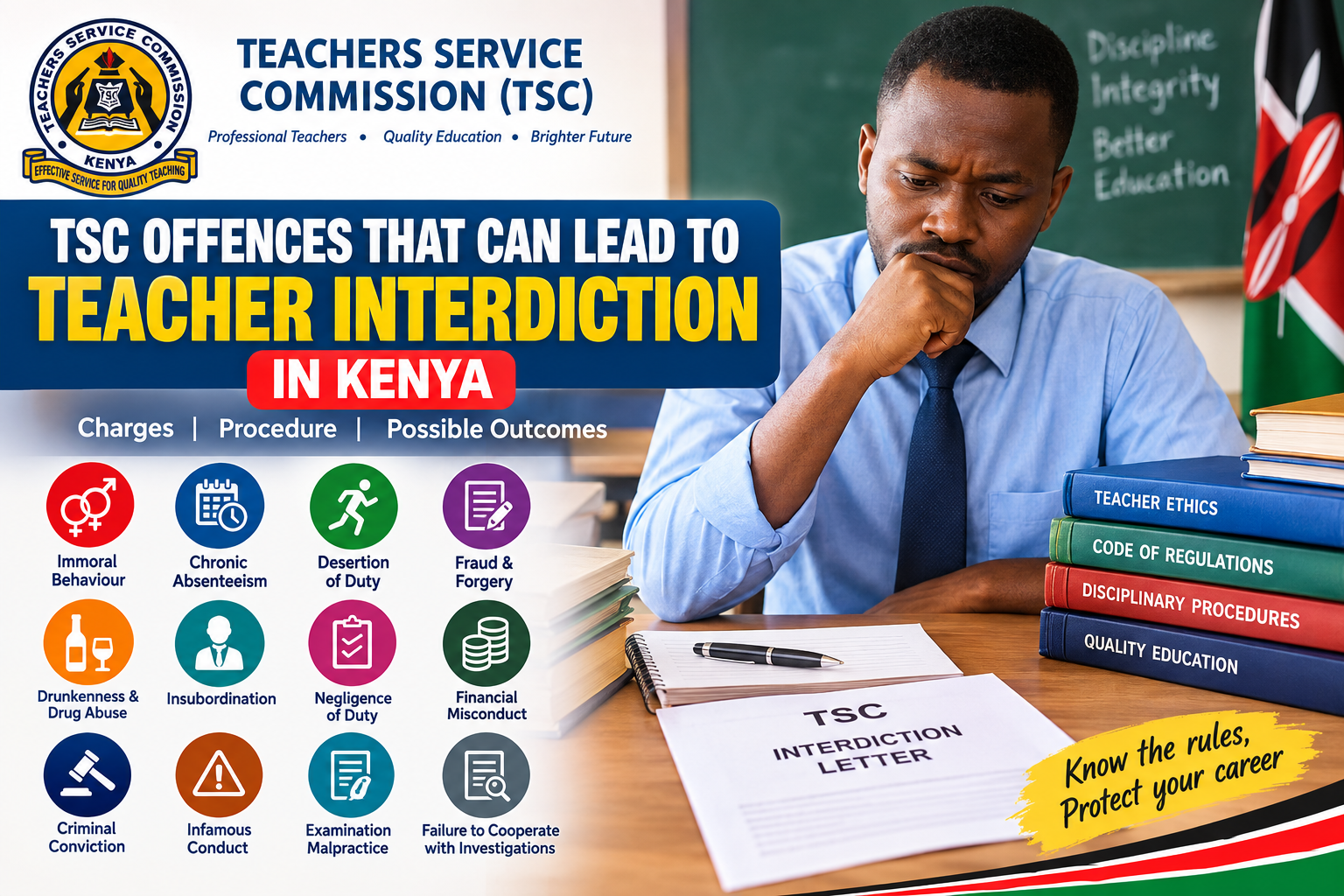
TSC Offences That Can Lead to Teacher Interdiction in Kenya: Charges, Procedure and Possible Outcomes
Teachers in Kenya are expected to uphold high standards of professionalism, integrity, discipline and conduct both inside and outside the classroom. Where a teacher is suspected of committing a serious breach of the applicable regulations, the Teachers Service Commission (TSC) may initiate disciplinary action, which can include interdiction.
Interdiction is an important part of the teacher disciplinary process. However, being interdicted does not by itself mean that a teacher has been found guilty. It is a disciplinary measure that allows the Commission to investigate and process allegations in accordance with the applicable rules and procedures.
The TSC Code of Regulations for Teachers provides for interdiction and sets out provisions concerning salary during interdiction, reporting requirements and disciplinary hearings.
This guide explains common categories of conduct that can expose a teacher to disciplinary action, what interdiction means, what happens after interdiction and some of the important issues teachers should understand.
What Is Teacher Interdiction?
Teacher interdiction is a formal disciplinary measure taken when a teacher is facing allegations of misconduct that require disciplinary proceedings.
It is important to distinguish interdiction from dismissal.
An interdicted teacher remains subject to the disciplinary process while the allegations are being considered. The eventual outcome can depend on the evidence, the teacher’s response, the disciplinary hearing and the Commission’s determination.
The TSC regulations provide for procedures relating to interdiction and subsequent disciplinary hearings. The regulations also provide for the teacher to be invited to a disciplinary hearing in writing.
TSC Offences That May Lead to Interdiction
The circumstances of individual cases differ, and not every allegation automatically results in interdiction. However, serious misconduct can expose a teacher to disciplinary action.
Below are major categories teachers should understand.
1. Immoral Behaviour and Sexual Misconduct
Sexual misconduct is among the most serious allegations that can face a teacher, particularly where learners are involved.
Examples can include:
- Sexual relations with a learner.
- Sexual harassment.
- Indecent acts.
- Inappropriate sexual communication with learners.
- Sexual exploitation or abuse.
- Conduct that places a learner at risk.
- Other prohibited sexual conduct under applicable law and regulations.
Where a teacher is accused of sexual misconduct involving a learner, the matter can have consequences beyond employment discipline because child-protection and criminal laws may also apply depending on the circumstances.
Teachers therefore have a professional responsibility to maintain appropriate boundaries with learners at all times.
Professional boundaries matter
Teachers interact with learners in positions of authority and trust. Communication through phones, social media, messaging applications and other digital platforms should therefore remain professional.
A teacher should avoid:
- Private sexual conversations with learners.
- Inappropriate photographs or videos.
- Sexual jokes or comments directed at learners.
- Secret meetings with learners.
- Romantic relationships with learners.
- Any conduct that could reasonably compromise professional boundaries.
2. Chronic Absenteeism
Regular attendance is a fundamental responsibility of a teacher.
A teacher who repeatedly fails to report to work without authorization or a valid explanation may face disciplinary action.
Chronic absenteeism can involve:
- Repeated absence from duty.
- Habitual lateness.
- Leaving the workplace without authorization.
- Failure to obtain permission for absence.
- Repeated failure to comply with attendance requirements.
Teachers experiencing genuine emergencies or circumstances that prevent them from reporting to work should use the appropriate official channels and maintain documentation where necessary.
Simply failing to appear at work without communicating with the relevant authorities can make a disciplinary situation more serious.
3. Desertion of Duty
Desertion of duty is another serious disciplinary issue.
The TSC regulations specifically contain provisions concerning desertion of duty. It is therefore important for teachers not to confuse authorized leave with unauthorized absence.
Where a teacher leaves duty without the required permission and remains absent, the matter can become subject to disciplinary proceedings.
Why desertion is serious
A teacher’s absence can affect:
- Curriculum coverage.
- Learner performance.
- Examination preparation.
- School administration.
- Other teachers who may have to cover lessons.
- Overall learning continuity.
Teachers who need to be away from duty should follow the applicable leave and reporting procedures rather than simply leaving the station.
4. Fraud, Forgery and Dishonest Dealings
Teachers are required to provide accurate information to TSC and maintain professional integrity.
Allegations involving fraudulent or dishonest conduct may therefore result in serious disciplinary action.
Examples may include:
- Forging academic certificates.
- Presenting false documents.
- Using fraudulent information to obtain employment.
- Using false documents to seek promotion.
- Falsifying official records.
- Making fraudulent claims.
- Impersonation.
- Collusion in fraudulent activities.
The TSC Code of Regulations specifically identifies issues such as fraudulent claims, false certificates, forgery, impersonation and collusion among matters associated with salary treatment during interdiction.
False information can have wider consequences
Teachers should also understand that submitting false information to a public institution can potentially create consequences beyond internal employment discipline, depending on the circumstances and applicable law.
5. Drunkenness and Drug Abuse
Teachers occupy positions of responsibility and are expected to maintain appropriate professional conduct.
Reporting to school while intoxicated or engaging in prohibited alcohol or drug-related conduct can expose a teacher to disciplinary action.
Possible examples include:
- Reporting for duty while intoxicated.
- Consuming alcohol while on duty where prohibited.
- Drug-related misconduct.
- Possession or use of prohibited substances.
- Conduct at school that demonstrates serious impairment.
The issue is not simply whether a teacher consumes alcohol privately. The disciplinary concern arises where conduct violates employment rules, affects performance, creates risks to learners or otherwise amounts to professional misconduct.
6. Insubordination
Teachers are expected to follow lawful and reasonable instructions issued through the appropriate administrative structures.
Insubordination may involve deliberately refusing to comply with a lawful instruction or openly disregarding legitimate authority.
Examples may include:
- Refusing lawful instructions from a supervisor.
- Deliberately ignoring official directives.
- Refusing assigned professional responsibilities without valid justification.
- Persistent defiance of administrative instructions.
- Disruptive conduct towards supervisors.
However, teachers should distinguish legitimate disagreement from insubordination.
A teacher who believes an instruction is improper should use the appropriate administrative or grievance channels rather than resorting to confrontation or deliberate defiance.
7. Neglect of Duty
Neglect of duty can occur when a teacher fails to perform important responsibilities assigned to them.
Examples may include:
- Repeatedly failing to teach scheduled lessons.
- Failure to prepare required professional documents.
- Failure to supervise learners where supervision is part of the assignment.
- Failure to perform assigned examination duties.
- Failure to carry out administrative responsibilities.
- Persistent failure to undertake assigned professional duties.
The TSC’s published descriptions of teaching responsibilities include lesson preparation, teaching, learner assessment, curriculum implementation and examination-related responsibilities.
Professional documentation
Teachers should also keep their professional records properly updated according to applicable requirements.
Depending on the teacher’s responsibilities, these may include:
- Lesson plans.
- Schemes of work.
- Records of work.
- Assessment records.
- Attendance records.
- Examination-related documentation.
- Other documents required by the institution or TSC.
8. Misappropriation or Mismanagement of Public Funds
Financial misconduct is another serious area of concern.
Teachers who have financial management responsibilities may be subjected to disciplinary action where there are allegations of:
- Misappropriation of school funds.
- Mismanagement of public resources.
- Fraudulent financial transactions.
- Falsification of financial records.
- Unauthorized use of institutional funds.
- Improper handling of school property or resources.
The TSC regulations expressly identify misappropriation or mismanagement of public funds among cases where the normal half-salary provision during interdiction does not apply.
This demonstrates the seriousness with which such allegations are treated.
9. Criminal Conviction and Criminal Conduct
A teacher’s employment can also be affected by criminal proceedings and convictions, depending on the nature and circumstances of the offence.
Issues involving:
- Theft.
- Fraud.
- Violence.
- Sexual offences.
- Corruption.
- Other serious criminal conduct.
may have professional consequences.
However, it is important to distinguish between an allegation, an arrest, a charge and a conviction. They are not the same thing.
A disciplinary process should therefore be understood in the context of the applicable regulations and the facts of the individual case.
10. Infamous Conduct
Teachers are expected to protect the dignity and reputation of the teaching profession.
Serious conduct that brings a teacher or the teaching profession into disrepute can result in disciplinary action.
Possible examples could include serious:
- Public misconduct.
- Corruption-related conduct.
- Fighting.
- Fraudulent activities.
- Abusive behaviour.
- Conduct seriously inconsistent with professional responsibilities.
The circumstances and evidence surrounding each case remain important.
11. Examination Malpractice and Professional Misconduct
National examinations require a high level of confidentiality and integrity.
Teachers involved in examination administration are expected to comply with applicable examination regulations.
Possible misconduct can include:
- Examination leakage.
- Unauthorized access to examination materials.
- Assisting candidates improperly.
- Altering examination information.
- Collusion.
- Unauthorized disclosure of confidential examination information.
- Other examination irregularities.
Teachers assigned examination responsibilities should therefore follow examination rules carefully and maintain the confidentiality of examination materials.
12. Failure to Cooperate With Disciplinary Investigations
A teacher facing disciplinary proceedings should take official correspondence seriously.
Ignoring disciplinary communication can create additional problems.
A teacher may be required to:
- Respond to an allegation.
- Provide relevant documents.
- Attend an interview or hearing.
- Respond to an interdiction letter.
- Cooperate with an investigation.
- Update contact information.
- Attend a disciplinary panel when formally invited.
The TSC regulations provide for written invitations to interdicted teachers for disciplinary hearings and specify methods through which such invitations may be communicated.
What Happens After a Teacher Is Interdicted?
Interdiction does not necessarily mean that the teacher has been dismissed.
The disciplinary process can continue through various stages.
Generally, the teacher may need to:
- Receive the disciplinary/interdiction communication.
- Understand the allegations or charges.
- Submit the required response.
- Provide relevant supporting information or documents.
- Attend the disciplinary hearing when invited.
- Present their case.
- Wait for the Commission’s determination.
The applicable TSC regulations should be consulted for the exact procedure and timelines in a particular case.
Does an Interdicted Teacher Receive Salary?
One of the most misunderstood issues surrounding interdiction is salary.
Under Regulation 148 of the TSC Code of Regulations for Teachers, a teacher is generally paid half salary during interdiction, but the regulations list specific exceptions. These include chronic absenteeism, desertion of duty, being jailed or held in legal custody, misappropriation or mismanagement of public funds, fraudulent claims and receipt of funds, use of false certificates, forgery, impersonation, collusion and immoral behaviour.
Therefore, the statement that “every interdicted teacher automatically receives half salary” is incomplete.
The specific allegation matters.
What Happens to a Teacher’s Salary in Serious Cases?
The salary provisions can differ depending on the charge.
For example, the TSC regulations identify certain allegations where the normal half-salary provision does not apply.
This is why teachers should carefully read their interdiction letters and understand the specific allegations against them rather than relying on general information circulating on social media.
How Long Can the Disciplinary Process Take?
The duration of a disciplinary case can vary depending on factors such as:
- The nature of the allegations.
- Availability of evidence.
- Investigations required.
- Availability of witnesses.
- The teacher’s response.
- Scheduling of the disciplinary hearing.
- Administrative processing.
The TSC regulations provide procedural requirements concerning invitations to disciplinary hearings. For example, the cited regulations state that an interdicted teacher is to be invited in writing to the hearing at least one month before the hearing date.
Teachers should therefore keep their contact details updated and respond appropriately to official communication.
Can an Interdicted Teacher Be Reinstated?
Yes, disciplinary proceedings do not necessarily end in dismissal.
Depending on the findings and applicable disciplinary provisions, a case can result in different outcomes.
Possible outcomes may include:
- Reinstatement.
- A warning or other disciplinary measure.
- Further disciplinary action.
- Dismissal.
- Other action permitted under the applicable regulations.
The outcome depends on the facts and determination of the particular case.
Can a Teacher Be Removed From the TSC Register?
Professional registration is a significant part of teaching in Kenya.
The TSC online system states that registration is required for persons engaging in the teaching service, pursuant to Article 237 of the Constitution and Section 23 of the Teachers Service Commission Act.
Serious professional or legal matters can therefore have consequences for a teacher’s professional status, depending on the applicable law and disciplinary determination.
Teachers should not assume that an employment disciplinary case and teacher registration issues are always identical; they can involve separate legal and regulatory considerations.
Important Difference Between Interdiction and Dismissal
These terms should not be used interchangeably.
Interdiction
Interdiction is a disciplinary measure while a case is being processed.
Dismissal
Dismissal is a more serious employment outcome following the disciplinary process.
Therefore:
Interdiction ≠ automatic dismissal.
A teacher should have the opportunity to respond to the allegations through the applicable disciplinary process.
What Should a Teacher Do After Receiving an Interdiction Letter?
Receiving an interdiction letter can be stressful, but the teacher should concentrate on responding properly and within the required procedures.
1. Read the letter carefully
Identify:
- The specific allegation.
- The dates involved.
- The conduct being complained about.
- Documents referred to.
- Required response.
- Deadline.
- Any reporting requirements.
Do not rely solely on verbal explanations.
2. Respond within the required period
If the letter requires a written response, the teacher should prepare and submit it according to the instructions.
The response should address the actual allegations rather than attacking other people involved in the matter.
3. Keep evidence
Relevant documents may include:
- Official letters.
- Leave applications.
- Medical or emergency documentation where relevant.
- Emails.
- Messages.
- Attendance records.
- Financial records.
- School records.
- Witness information.
- Other documents relevant to the allegations.
Teachers should retain copies of documents submitted to authorities.
4. Attend the disciplinary hearing
If formally invited to a hearing, the teacher should take the invitation seriously.
The TSC regulations provide for formal written invitations to disciplinary hearings.
Failure to engage with the process can make it harder for the teacher to present their side of the matter.
5. Seek appropriate professional or legal advice
Where the allegation is serious, particularly where criminal proceedings, sexual misconduct, financial allegations or professional registration issues are involved, obtaining independent legal advice may be appropriate.
Common Mistakes Teachers Should Avoid
Teachers facing disciplinary action should avoid making the situation more difficult through careless actions.
Mistake 1: Ignoring the interdiction letter
Silence does not necessarily resolve a disciplinary case.
Mistake 2: Missing official hearings
Always take formal invitations seriously.
Mistake 3: Destroying documents
Relevant evidence should be preserved.
Mistake 4: Giving contradictory explanations
Teachers should provide accurate and consistent information.
Mistake 5: Posting details of the case irresponsibly on social media
Public arguments can complicate an already sensitive matter.
Mistake 6: Assuming interdiction means automatic dismissal
Interdiction is part of a disciplinary process; the final outcome depends on the case.
How Teachers Can Reduce the Risk of Disciplinary Problems
Prevention is often easier than dealing with a disciplinary case.
Teachers can protect themselves professionally by:
Maintain professional boundaries
Always maintain appropriate relationships with learners, parents and colleagues.
Follow official procedures
Apply for leave and permission through the correct channels.
Keep accurate records
Maintain professional documentation required for your responsibilities.
Protect school resources
Handle institutional funds, equipment and property responsibly.
Follow examination regulations
Treat examination materials and information as confidential.
Respect lawful instructions
Where disagreements arise, use appropriate administrative channels.
Maintain professional communication
Messages, emails and social media interactions involving colleagues and learners should remain appropriate.
TSC Teacher Discipline: Key Points at a Glance
| Issue | Why It Can Be Serious |
|---|---|
| Immoral or sexual misconduct | Can breach professional and legal obligations |
| Chronic absenteeism | Affects teaching and learning |
| Desertion of duty | Constitutes serious unauthorized absence |
| Fraud or forgery | Raises integrity and employment concerns |
| Drug or alcohol-related misconduct | Can affect professional conduct and safety |
| Insubordination | May involve refusal to follow lawful instructions |
| Neglect of duty | Can affect curriculum delivery |
| Financial misconduct | Involves public or institutional resources |
| Criminal conduct | May have employment and professional consequences |
| Infamous conduct | Can undermine professional standards |
| Examination malpractice | Threatens examination integrity |
| Failure to cooperate | Can complicate disciplinary proceedings |
Final Thoughts for Kenyan Teachers
Teacher discipline is an important part of maintaining professional standards in Kenya’s education system. Allegations of serious misconduct can have significant consequences, but it is equally important to understand that an allegation is not the same as a final finding of guilt.
Teachers should therefore familiarize themselves with the applicable TSC regulations, employment obligations and professional standards.