
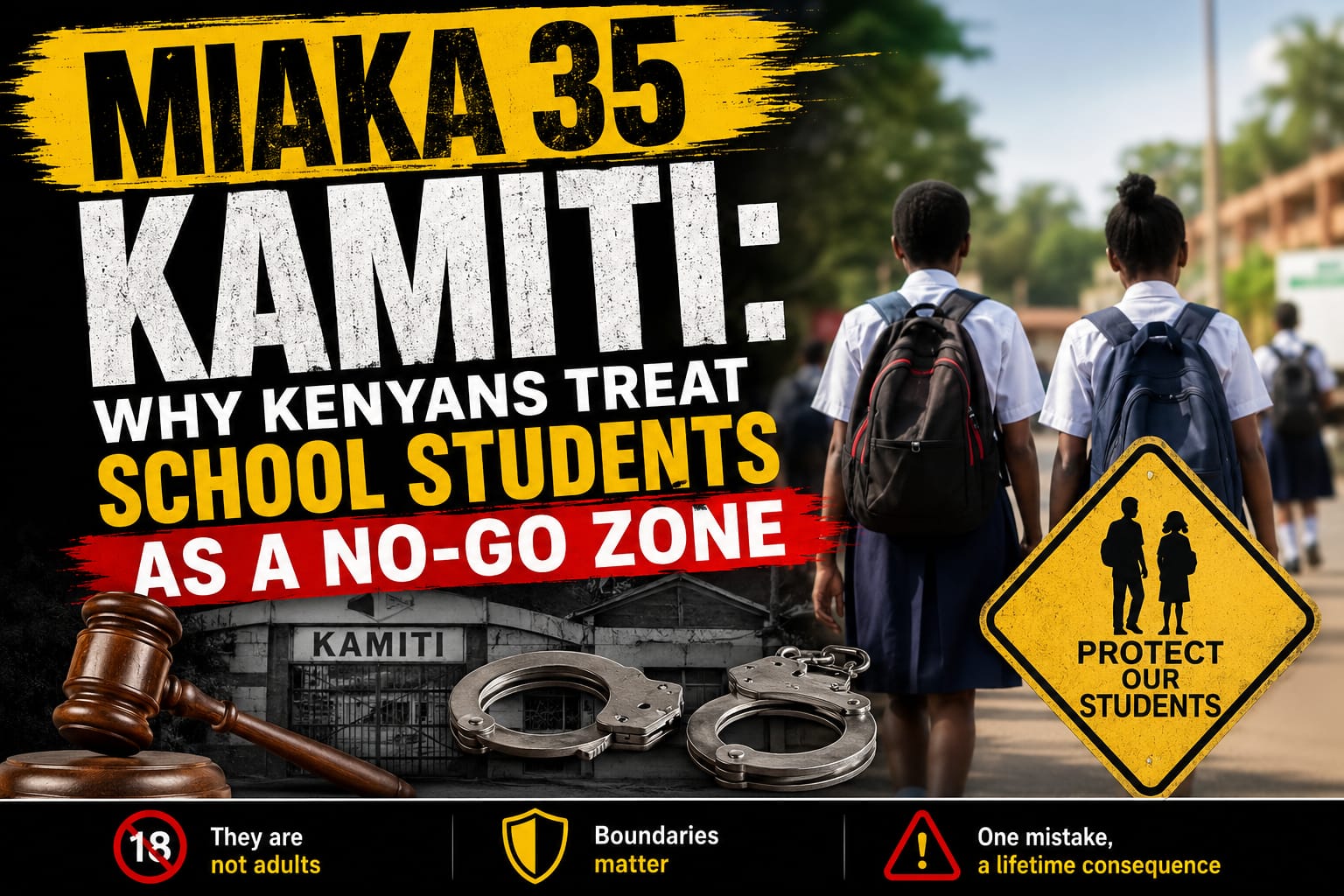
Kenyans are known for their boldness, humor, and ability to turn almost anything into a conversation.
From politics to everyday struggles, humor often becomes the bridge that connects people. Social media platforms, street conversations, and group chats are full of jokes, memes, and witty remarks that travel fast and hit hard.
But there is one topic that instantly changes the mood.
The moment someone mentions relationships involving school-going students, the laughter fades—and a familiar warning quickly follows:
“Miaka 35 Kamiti.”
⚠️ The Warning Everyone Understands
Across estates, campuses, and online spaces, the phrase “miaka 35 Kamiti” has become a cultural signal.
It may be said jokingly, but its meaning is crystal clear: 👉 There are serious consequences for crossing that line.
Friends use it to caution each other without sounding overly harsh. Someone might make a careless joke, and instantly another responds with the phrase—half-laughing, but fully serious.
It’s humor, yes—but it carries weight.
😂 Humor That Carries a Serious Message
One unique aspect of Kenyan culture is how humor is used to communicate serious issues.
Instead of long lectures or moral arguments, a simple phrase backed by memes, videos, and street talk spreads the message faster and more effectively.
“Kamiti” has become more than just a place—it’s a symbol of consequences.
This approach works because:
It’s easy to remember
It spreads quickly
It softens delivery while keeping the message strong
In short, humor makes the warning stick.
🧠 Why School Students Can Be Misunderstood
Adolescence is a complex stage of life.
During this period:
Teenagers undergo physical changes
Some may appear older than their actual age
Emotional and mental maturity is still developing
This mismatch can sometimes lead to confusion, especially in public spaces where age is not immediately obvious.
However, experts emphasize one critical point:
👉 Appearance does not equal maturity.
School-going students are still minors. They are in a stage of growth, self-discovery, and vulnerability—and they require protection, not exploitation.
🚧 A Boundary Society Strongly Defends
In a country with diverse opinions on many issues, this is one area where there is strong agreement.
Across communities:
School students are considered off-limits
Crossing that line is socially condemned
People speak out quickly when boundaries are violated
This isn’t just about the law—it’s about shared responsibility.
Protecting young people is a collective duty.
⚖️ The Reality Behind the Joke
While “miaka 35 Kamiti” is often delivered with a laugh, the consequences behind it are very real.
Such actions can lead to:
Arrest and prosecution
Lengthy prison sentences
Permanent damage to one’s reputation and future
The humor may soften the tone, but it does not erase the seriousness.
People understand that what’s at stake is not just freedom—but a lifetime of consequences.
🌍 The Bigger Picture
At its core, this cultural phrase reflects something deeper about Kenyan society.
It shows how:
Communities enforce boundaries
Humor becomes a tool for education
Shared values are passed down informally
“Miaka 35 Kamiti” is more than a joke—it’s a reminder.
A reminder that no matter how casual or bold conversations may get, there are lines that should never be crossed.
✍️ Final Thought
In a world where messages often get lost in noise, Kenyans have found a way to keep this one loud and clear.
Through laughter, memes, and everyday talk, the message continues to spread:
School-going students are a no-go zone. Always